



Have you ever wondered whether to write wise or wize? The spelling Wise vs. Wize can be confusing because both versions sound exactly alike, making it easy to mix them up when writing a message, completing an assignment, or publishing an article. However, only one is the standard spelling for describing someone who makes good decisions.
Wise is the correct spelling when you mean sensible, knowledgeable, or capable of making sound judgments. Wize is generally a misspelling of this word in standard English, although it may appear intentionally in brand names, usernames, and other proper names.
Understanding the difference helps you avoid spelling errors and express your ideas clearly. It also helps you recognize related expressions, choose suitable synonyms, and use wise naturally in everyday communication.
This guide explains the meanings of wise and wize, provides practical examples, explores common mistakes, and includes exercises to help you remember the correct spelling.
Wise vs. Wize: What’s thCe Difference?
The main difference between wise and wize is their spelling status. English dictionaries recognize wise as the standard adjective for describing good judgment and sound decision-making. Wize is not a standard alternative spelling when you intend to express that meaning.
The word describes someone who can make good judgments based on understanding and experience.
For example, consider these sentences:
- Correct: My grandmother gave me wise advice.
- Incorrect: My grandmother gave me wize advice.
- Correct: It was wise to save money for emergencies.
- Incorrect: It was wize to save money for emergencies.
Both spellings sound alike in ordinary pronunciation. The difference becomes visible when you write them down.
Wise vs. Wize Comparison Table
| Feature | Wise | Wize |
| Standard English spelling | Yes | No, not as a substitute for wise |
| Main meaning | Showing good judgment or understanding | No standard equivalent meaning |
| Part of speech | Primarily an adjective | Depends on its use as a name or stylized form |
| Correct example | She made a wise decision. | Wize is the name of a fictional app. |
| Appropriate in formal writing | Yes | Only when the context justifies the spelling |
| Pronunciation | /waɪz/ | Usually the same when intended as a stylized spelling |
The table highlights an important distinction: an unconventional spelling can appear in a legitimate name without becoming a standard English spelling.
For everyday writing, remember this simple rule: Use wise when describing good judgment, intelligence informed by experience, or sensible behavior.
Confused about whether to use “Enable” or “Inable”? Read our guide on Enable vs. Inable to discover the correct spelling, meanings, and proper usage with helpful examples.
What Does Wise Mean?
The word wise describes a person, decision, action, or piece of advice that shows sound judgment. It often suggests that someone has considered the available information, anticipated possible consequences, and chosen an appropriate response.
Wisdom involves more than knowing facts. A person might possess extensive knowledge yet make poor decisions. Someone else might have less formal education but use experience, careful thought, and practical judgment effectively.
For example, a student who studies every night may be hardworking. A student who identifies weak areas, creates a realistic study schedule, and gets enough rest also demonstrates wise planning.
In other words, being knowledgeable means understanding information, while being wise means using knowledge and experience well.
Wise as an Adjective
In its most common use, wise is an adjective. It describes a noun by explaining the quality of a person, choice, action, or recommendation.
Here are several common combinations:
- A wise person: Someone who makes thoughtful decisions.
- A wise decision: A choice supported by sound judgment.
- Wise advice: Guidance that helps someone act sensibly.
- Wise spending: Using money carefully and responsibly.
- A wise approach: A practical method that considers likely outcomes.
- Wise leadership: Leadership that combines judgment, responsibility, and foresight.
Consider these examples:
- It was wise to compare several insurance policies before choosing one.
- The manager made a wise decision by asking the team for feedback.
- Her wise advice helped him avoid an unnecessary expense.
- A wise investor considers risk instead of focusing only on possible profits.
- Taking a short break was a wise choice after several hours of studying.
Notice that wise doesn’t describe a person’s intelligence alone. It often emphasizes how someone applies what they know.
Wise Person Meaning: Understanding True Wisdom
A wise person tends to think carefully, learn from experience, and consider the consequences of their actions. Such a person may recognize when to act, when to wait, and when to seek advice.
Wisdom also involves recognizing personal limitations. Someone who admits uncertainty and checks the facts before making a decision may demonstrate better judgment than someone who confidently assumes they’re always right.
Imagine a small business owner whose sales suddenly decline. One response would be to cut every expense immediately. A wiser approach might involve reviewing customer feedback, checking operating costs, and identifying which changes would solve the actual problem.
The second approach reflects thoughtful judgment rather than a quick reaction.
A wise person may demonstrate qualities such as:
- Patience: Taking time to understand a situation before responding.
- Perspective: Looking beyond immediate benefits or frustrations.
- Experience: Applying lessons learned from earlier successes and mistakes.
- Humility: Accepting that personal knowledge has limits.
- Prudence: Avoiding unnecessary risks and considering likely consequences.
- Empathy: Understanding how decisions may affect other people.
Wisdom doesn’t guarantee perfect decisions. Even experienced people make mistakes. What matters is their ability to evaluate situations, learn from outcomes, and adjust their approach.
Wise as a Verb or Part of Other Expressions
Although wise primarily functions as an adjective, it also appears in established expressions and related word forms.
The phrasal verb wise up means to become better informed or more aware of a situation.
For example:
- You should wise up to the risks of sharing personal information online.
- He finally wised up and stopped trusting suspicious messages.
The word also appears in compounds such as streetwise and worldly-wise. These terms describe practical awareness gained through experience.
The suffix -wise has a separate grammatical use. In words such as clockwise and lengthwise, it expresses direction or manner. In informal expressions such as money-wise, it can mean “regarding money.”
These forms are legitimate uses of wise or its related suffix. They don’t make wize an accepted substitute.
What Does Wize Mean?
In ordinary English, wize has no standard dictionary meaning equivalent to the adjective wise. If you want to describe a sensible decision, an experienced person, or thoughtful advice, you should use wise.
However, context matters. People sometimes choose unconventional spellings for creative projects, business names, usernames, and online identities.
For example, a fictional company might call its budgeting app WizeBudget because the spelling looks distinctive. The name may be intentional, but that doesn’t mean writers should use wize in ordinary sentences.
Compare these examples:
- Standard English: The teacher offered wise guidance.
- Nonstandard spelling: The teacher offered wize guidance.
- Intentional name: WizeBudget helps users organize their monthly expenses.
In the final example, WizeBudget is a fictional brand name. Its spelling serves as an identifying label rather than a standard English adjective.
Is Wize Ever Correct?
Yes, Wize may be correct when it forms part of an established proper name or a deliberately stylized name. Proper names don’t always follow ordinary spelling conventions.
You might encounter an unusual spelling in:
- A company or product name.
- A social media username.
- A fictional character’s name.
- A website or online service.
- A creative project or marketing campaign.
The important question is whether the writer intends to use a name or an ordinary English word.
For instance, if a company officially uses Wize in its registered or public-facing name, preserve that spelling when referring to the company. If you’re describing someone’s judgment, however, write wise.
A brand name can use creative spelling without changing the standard spelling of the underlying English word.
Wondering whether “Holliday” or “Holiday” is the correct spelling? Check out our guide on Holliday vs. Holiday to learn the correct spelling, meaning, and usage with easy examples.
How to Use Wise Correctly in a Sentence
Once you understand the meaning of wise, using it correctly becomes straightforward. The word commonly appears before a noun or after a linking verb.
Wise Before a Noun
When wise appears before a noun, it describes the person or thing named by that noun.
Examples include:
- She made a wise investment after researching the market.
- His father offered wise counsel during a difficult period.
- Choosing a reliable supplier was a wise move.
- The team adopted a wise strategy for managing its workload.
- Buying essential supplies early proved to be a wise decision.
In each sentence, wise describes the quality of a decision, recommendation, or action.
Wise After a Linking Verb
You can also use wise after linking verbs such as be, seem, and appear.
Examples:
- Your suggestion seems wise.
- It was wise to ask for clarification.
- Their decision proved wise.
- She is wise beyond her years.
- It would be wise to review the contract before signing it.
The expression “It would be wise to…” is especially useful when offering advice politely.
For example, “It would be wise to back up your files before installing the update” sounds measured and practical rather than forceful.
Common Expressions With Wise
English contains several established expressions that use wise. Learning them will help you recognize the word in different contexts.
| Expression | Meaning | Example |
| Wise choice | A sensible decision | Taking the earlier train was a wise choice. |
| Wise words | Thoughtful or helpful advice | Her wise words helped me reconsider. |
| Wise up | Become better informed or aware | You need to wise up to online scams. |
| Streetwise | Skilled at handling practical situations | The streetwise traveler recognized the trick. |
| Worldly-wise | Experienced in how the world works | He became more worldly-wise after years abroad. |
| Penny-wise and pound-foolish | Saving small amounts while risking much larger costs | Buying cheap equipment that repeatedly breaks can be penny-wise and pound-foolish. |
| None the wiser | Still not understanding or knowing something | After the explanation, I was none the wiser. |
| Wise to something | Aware of a trick, problem, or hidden situation | Customers are becoming wise to misleading advertising. |
Some expressions carry meanings that differ from the basic definition of wise. For instance, a wise guy can mean someone who makes sarcastic or cheeky remarks. The phrase may sound critical rather than complimentary.
Wise vs. Wisely: What’s the Difference?
The words wise and wisely are related, but they serve different grammatical functions.
Wise is an adjective. It describes a person, decision, or action.
Wisely is an adverb. It describes how someone performs an action.
Compare the following sentences:
| Wise | Wisely |
| That was a wise decision. | She decided wisely. |
| He gave wise advice. | He wisely followed the advice. |
| They made a wise investment. | They invested wisely. |
| It was wise to wait. | She wisely waited for more information. |
A useful test is to ask what the word describes. If it describes a noun, wise is generally appropriate. If it describes how an action happens, wisely may be the correct choice.
For example, “He answered wisely” describes how he answered. “His answer was wise” describes the answer itself.
Wise vs. Wize: Correct and Incorrect Examples
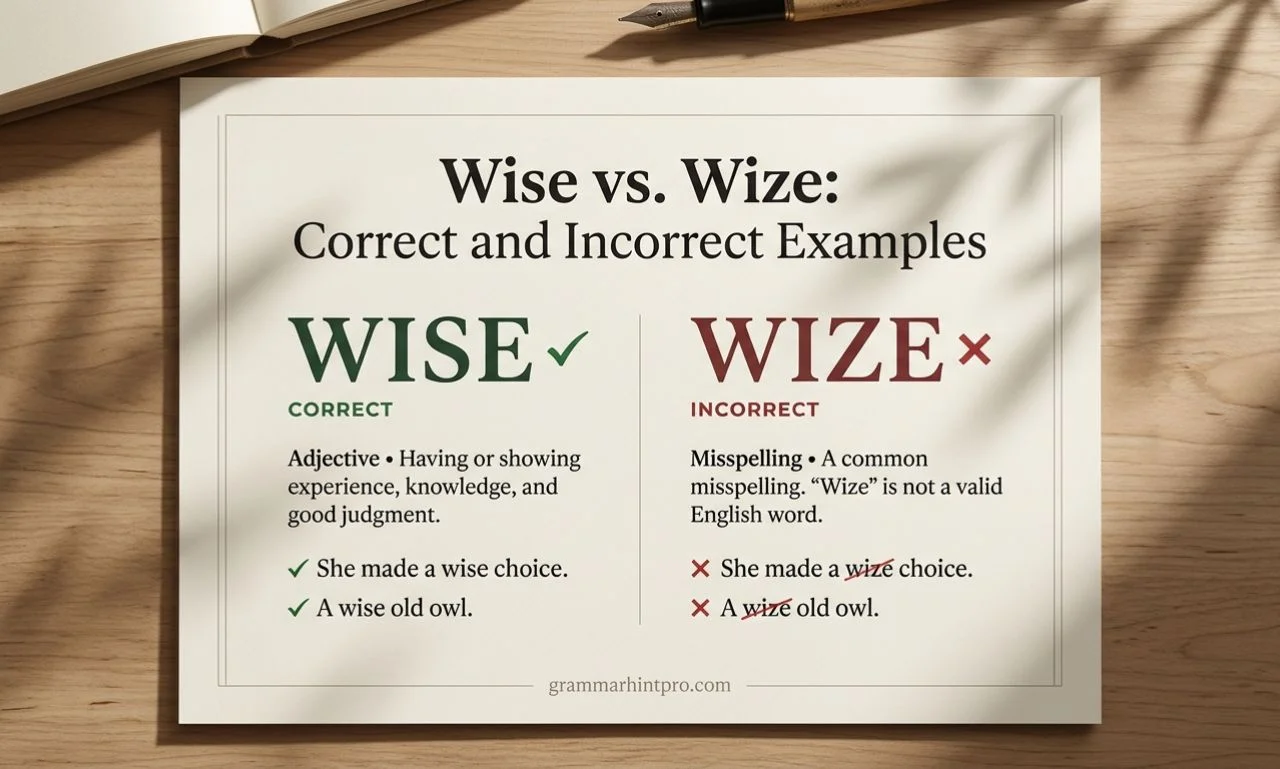
Spelling mistakes often go unnoticed because the intended meaning remains clear. Nevertheless, the wrong spelling can make professional writing appear less polished.
The following examples show how to correct common uses of wize when the writer intends to use the standard adjective.
Common Sentence Corrections
| Incorrect sentence | Correct sentence | Explanation |
| She made a wize decision. | She made a wise decision. | Wise is the standard spelling. |
| It is wize to save money. | It is wise to save money. | The adjective describes a sensible action. |
| He gave me some wize advice. | He gave me some wise advice. | Use wise to describe thoughtful guidance. |
| That was a wize investment. | That was a wise investment. | The decision shows good judgment. |
| My grandfather is a very wize man. | My grandfather is a very wise man. | Wise describes a person’s judgment and experience. |
| We made a wize choice by leaving early. | We made a wise choice by leaving early. | The spelling must follow standard English usage. |
The same principle applies in academic essays, business reports, emails, and website content.
A Practical Case Study: Editing a Business Email
Imagine that an employee writes the following sentence in a project update:
“It would be wize to review the budget before approving the new expenses.”
The meaning is understandable, but the spelling is incorrect for standard business writing.
A corrected version reads:
“It would be wise to review the budget before approving the new expenses.”
The revision fixes the spelling without changing the meaning or tone. It also preserves the sentence’s polite recommendation.
Now consider a different sentence:
“WizeTrack released a new budgeting tool.”
If WizeTrack is the product’s actual name, the spelling may be correct. An editor should verify the official name rather than automatically changing it to WiseTrack.
This example illustrates a useful editing principle: Correct spelling errors, but don’t alter proper names without checking them.
Unsure whether “Referred” or “Refered” is the correct spelling? Check out our guide on Referred vs. Refered to understand the spelling difference, meaning, and correct usage with helpful examples.
Wise Synonyms and Related Words
Synonyms help you express the particular kind of judgment you want to describe. Although several words overlap with wise, they don’t all communicate exactly the same idea.
Choosing a precise synonym can make your writing clearer and less repetitive.
Common Synonyms for Wise
| Synonym | Meaning or emphasis | Example |
| Sensible | Practical and reasonable | It was sensible to bring an umbrella. |
| Prudent | Careful about risks and future consequences | A prudent buyer checks the terms before paying. |
| Judicious | Showing careful judgment when making a choice | The editor made a judicious selection of sources. |
| Insightful | Showing a deep understanding of a subject | Her insightful comments revealed the real problem. |
| Discerning | Able to recognize important differences or quality | A discerning reader checks the evidence. |
| Sagacious | Showing exceptional judgment or understanding | The sagacious adviser anticipated the difficulty. |
| Experienced | Having practical knowledge gained through time or activity | An experienced mechanic identified the fault. |
| Thoughtful | Showing careful consideration for people or circumstances | He gave a thoughtful response. |
| Astute | Quick to notice important details and understand situations | The astute negotiator spotted a weakness in the proposal. |
These words aren’t interchangeable in every sentence.
For example, prudent often emphasizes caution and risk management. Insightful focuses on depth of understanding, while astute suggests sharp perception.
Similarly, an experienced person has accumulated practical knowledge, but experience alone doesn’t guarantee wisdom.
How to Choose the Right Synonym
Start by identifying the quality you want to emphasize.
- Use sensible when a choice seems reasonable and practical.
- Use prudent when someone considers risks or protects future interests.
- Use judicious when a decision reflects balanced evaluation.
- Use insightful when someone understands a complicated issue deeply.
- Use discerning when someone distinguishes between quality, value, or important details.
- Use astute when someone quickly recognizes an advantage or hidden problem.
- Use sagacious in formal or literary writing when you want to emphasize exceptional wisdom.
Consider this example:
“The manager made a wise decision.”
That sentence works well in most contexts. However, “The manager made a prudent decision by keeping emergency funds available” communicates the specific reason the decision was wise.
The more precise word adds information rather than merely replacing one adjective with another.
Wise in Slang and Informal English
The word wise appears in everyday expressions, informal speech, and idioms. These uses expand its meaning, but they don’t change its spelling.
Wise Up
To wise up means to become more aware of facts, risks, or tricks.
Examples:
- It’s time to wise up to fake job offers.
- She wised up after losing money to a dishonest seller.
- Consumers are beginning to wise up to misleading marketing claims.
The expression is informal and often suggests that someone has finally recognized something they previously failed to notice.
Wise Guy
A wise guy is someone who makes clever, sarcastic, or cheeky remarks. Depending on the situation, the phrase can sound playful or insulting.
For example:
“Don’t be a wise guy. I’m asking you a serious question.”
Here, wise guy doesn’t mean a genuinely wise person. It refers to someone who responds with an irritating or sarcastic comment.
Wise to Something
Being wise to something means knowing about a situation, especially a trick or dishonest practice.
For example:
“After several suspicious emails, the employees became wise to the scam.”
This expression emphasizes awareness rather than general wisdom.
Informal expressions may have specialized meanings, but wize remains a nonstandard substitute when you intend to write the ordinary word wise.
Why Do People Confuse Wise and Wize?
The confusion usually comes from the relationship between pronunciation and spelling, along with the influence of online communication.
Similar Pronunciation
Wise and wize are generally pronounced the same when someone uses the latter as an alternative spelling. Because the spoken form doesn’t reveal which spelling a writer intends, the distinction depends on written conventions.
English contains many words whose spelling cannot be predicted perfectly from pronunciation. Writers must often learn the standard written form through reading, practice, and reference tools.
Informal Online Writing
Text messages, usernames, gaming profiles, and social media posts encourage creative spelling. People may replace letters to make a name distinctive or fit a particular style.
A person might choose WizeWriter as a username. That choice doesn’t establish wize as the correct spelling in a school assignment or professional report.
Typing Errors and Autocorrect
A writer may accidentally type wize while drafting quickly. Autocorrect and spell-checking tools can catch many such mistakes, but their performance depends on the application and context.
Proper names create an additional challenge. A tool might flag an unfamiliar brand name as an error even when the spelling is intentional.
Confusion About Word Formation
The legitimate suffix -wise can also cause uncertainty. Words such as clockwise and lengthwise use this spelling to express direction or manner. Informal forms such as money-wise refer to a particular subject.
These established forms follow their own usage patterns. They don’t provide a reason to replace the final s in the ordinary adjective wise with a z.
For more helpful grammar tips, spelling explanations, and easy-to-understand English lessons, visit Grammar Hint Pro and improve your English skills.
How to Remember the Correct Spelling of Wise

A simple memory trick can help you choose the correct spelling consistently.
Remember the S in wise as the S in sensible. Both words relate to making reasonable choices, although they have different meanings.
You can also use the following habits to reduce spelling errors:
- Read the complete sentence. Ask whether you mean good judgment or whether you’re referring to a name.
- Check the dictionary. Use a reliable reference when you’re unsure about an unfamiliar spelling.
- Use spell-checking tools. Review flagged words instead of accepting every suggested change automatically.
- Create a personal word list. Record words you frequently misspell and review them before submitting important writing.
- Proofread proper names separately. Verify company, product, and personal names against reliable sources.
- Practice with examples. Writing several correct sentences helps reinforce the standard spelling.
One important point: reading the sentence aloud won’t necessarily help distinguish wise from wize. They sound alike in ordinary use. Proofreading must focus on spelling and meaning rather than pronunciation alone.
Frequently Asked Questions
Q1. Is Wise or Wize Correct?
Wise is correct when you mean sensible, experienced, or capable of making good judgments. Wize is not a standard alternative spelling of this adjective.
Q2. Is Wize a Real Word?
Wize may appear as a proper name, username, brand, or stylized spelling. However, it isn’t the standard spelling to use when describing someone or something as wise.
Q3. Does Wize Mean Smart?
Not as a standard English alternative to wise. If you want to say that someone has good judgment or uses knowledge effectively, write wise. If Wize appears in a particular brand or name, its meaning depends on that context.
Q4. Why Do People Spell Wise as Wize?
People may use wize because the words sound alike, because they make a typing mistake, or because they prefer a distinctive online name. The reason depends on the situation.
Q5. Is Wise the Same as Intelligent?
The meanings overlap, but they aren’t identical. Intelligent generally describes the ability to learn, understand, reason, or solve problems. Wise emphasizes good judgment and the effective use of knowledge or experience.
An intelligent person can make an unwise decision. Likewise, a wise person may recognize the limits of their knowledge and ask someone else for help.
Conclusion
The difference between wise and wize is simple but important. Wise is the standard English spelling for describing good judgment, sensible decisions, and the thoughtful use of knowledge or experience. Wize is generally incorrect when used as a substitute for this adjective.
The exception is intentional spelling in proper names, such as brands, usernames, or fictional characters. In those cases, the spelling depends on the name itself rather than the standard adjective.
When writing an essay, email, business report, or article, choose wise whenever you mean sensible or showing wisdom. Check unfamiliar names before correcting them, and use examples or dictionary references when uncertainty remains.
Remember the practical rule: A wise decision uses good judgment, and the word wise uses the standard spelling.
2 thoughts on “7 Powerful Tips: Wise vs. Wize – Which Is Correct?”