


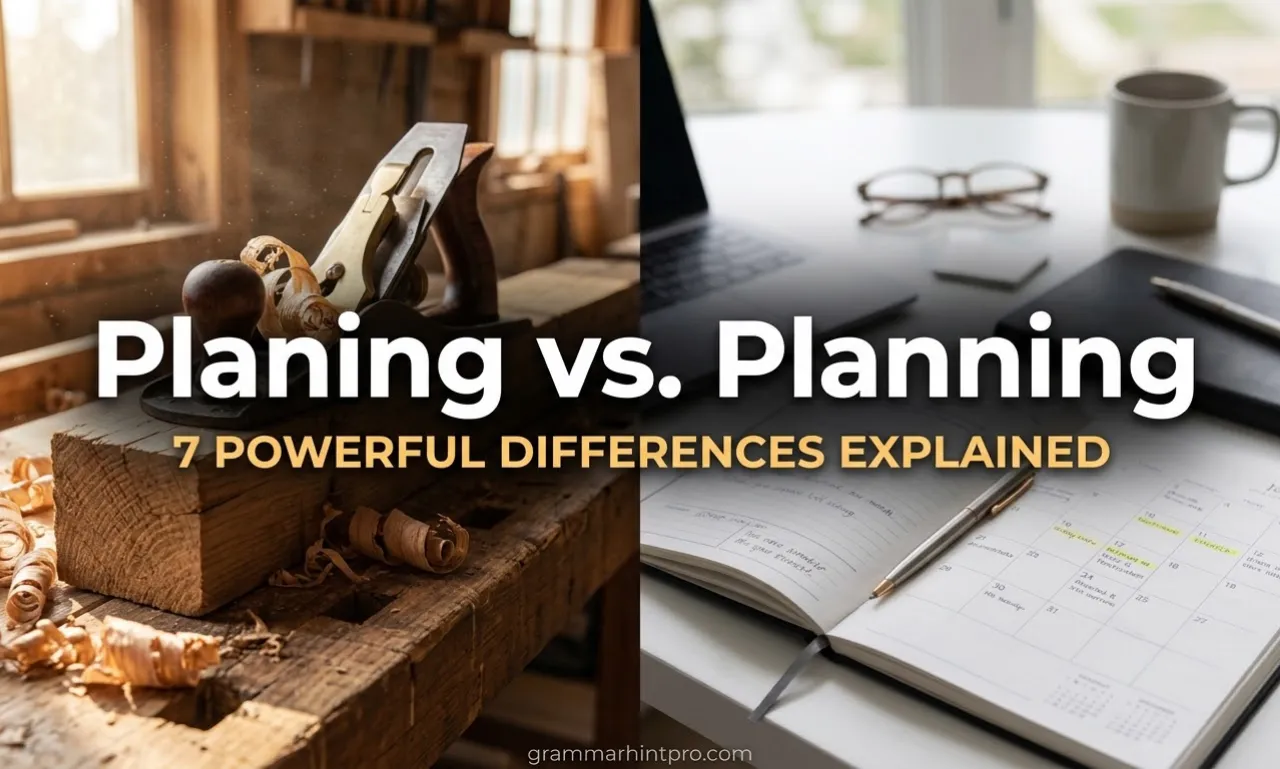
Have you ever typed planing when you meant planning? The difference is just one letter, but that small change can completely alter your sentence. Both spellings are correct English words. However, they serve different purposes and follow different spelling patterns.
Planning means preparing, organizing, or deciding what to do in the future. You might be planning a vacation, a business meeting, or your next career move. Planing, on the other hand, usually refers to smoothing wood with a special tool or describes a boat skimming across the water.
Understanding the difference helps you avoid spelling mistakes in emails, school assignments, business documents, and everyday conversations. Once you learn where each word comes from, choosing the correct spelling becomes much easier.
Planing vs. Planning: The Quick Answer
The easiest way to distinguish planing vs. planning is to look at the meaning of the sentence. If you’re organizing something or preparing for the future, use planning. If you’re smoothing a surface with a plane or describing a boat’s movement across water, planing may be the correct choice.
Here’s a quick comparison:
| Feature | Planning | Planing |
| Base word | Plan | Plane |
| Main meaning | Preparing or organizing | Smoothing a surface or moving across water in a planing condition |
| Spelling pattern | Doubles the final n before adding -ing | Drops the silent e before adding -ing |
| Common contexts | Work, education, travel, personal goals | Woodworking, carpentry, boating |
| Example | We’re planning a family trip. | The carpenter is planing a wooden board. |
Consider these examples:
- Planning: Maria is planning her wedding for next spring.
- Planing: The carpenter is planing a rough wooden door.
- Planning: The company is planning to launch a new product.
- Planing: The speedboat is planing across the lake.
Notice how the surrounding words help you identify the intended meaning. A wedding, product launch, or family trip involves preparation. A wooden board involves a physical process, while a speedboat may plane across the water under suitable operating conditions.
Quick rule: If you’re making plans, write planning. If you’re working with a plane tool or describing a boat’s movement, consider planing.
Confused about whether to write “Forest” or “Forrest”? Read our guide on Forest vs. Forrest to understand their meanings, spelling differences, and correct usage with simple examples.
What Does Planning Mean?

Planning describes the process of thinking ahead, setting objectives, organizing resources, and deciding which actions to take. It can involve something as simple as preparing tomorrow’s lunch or as complex as coordinating a large construction project.
At its core, planning helps you move from an idea to a practical course of action. Instead of making decisions at the last minute, you consider your options, identify what you need, and arrange the steps in a sensible order.
For example, imagine you’re organizing a weekend trip. You choose a destination, compare transportation options, set a budget, and decide where to stay. All these activities form part of the planning process.
Planning Definition and Meaning
In everyday English, planning is the present participle and gerund form of the verb plan.
The word can serve different grammatical functions depending on how you use it.
As a present participle, planning helps form continuous verb tenses:
- She is planning a family reunion.
- They were planning a new advertising campaign.
- We have been planning this project for months.
In these sentences, planning describes an ongoing activity.
As a gerund, planning functions as a noun:
- Planning takes time and careful thought.
- We discussed planning for the upcoming event.
- Good planning can prevent unnecessary delays.
Although the grammatical roles differ, the spelling remains the same. In both cases, the word contains two N’s because it comes from the verb plan.
Planning in Everyday English
Planning appears in countless ordinary situations because people regularly make decisions about future activities.
For example, you might plan your meals before grocery shopping, arrange appointments around your work schedule, or prepare a study timetable before an examination. Each activity involves deciding what needs to happen and when.
Here are several common uses:
- Daily planning: Organizing errands, appointments, chores, and personal responsibilities.
- Travel planning: Choosing destinations, arranging transportation, and estimating expenses.
- Academic planning: Scheduling study sessions, selecting courses, and preparing for exams.
- Career planning: Setting professional goals and identifying the skills needed to achieve them.
- Financial planning: Managing income, expenses, savings, and future financial needs.
Planning doesn’t always require a formal document. Sometimes, a short checklist or a few notes on your phone provide enough structure.
However, more complicated tasks often benefit from written schedules, budgets, deadlines, and clearly assigned responsibilities.
Planning vs. Plan: What’s the Difference?
The words plan and planning share the same root, but they don’t always serve the same grammatical purpose.
A plan can be a noun that describes an intended course of action. It can also be a verb that means to prepare or arrange something.
Planning usually refers to the process of preparing or the ongoing activity of making arrangements.
| Word | Part of speech | Example |
| Plan | Noun | Our plan includes three important steps. |
| Plan | Verb | We plan to visit our relatives. |
| Planning | Present participle | We are planning a family reunion. |
| Planning | Gerund | Planning requires patience. |
Think of it this way: the plan is the intended route, while planning is the work involved in choosing that route.
For instance, a project manager might spend two weeks planning a project before producing a final project plan. The two expressions are closely related, but they don’t mean exactly the same thing.
Why Is Planning Spelled With Two N’s?
The double N in planning follows a common English spelling rule called the consonant-doubling rule. When you understand this pattern, you’ll also find it easier to spell many other words correctly.
The rule explains why plan becomes planning rather than planing when you add the suffix -ing.
The Consonant-Doubling Rule Explained
In many cases, English doubles the final consonant of a short verb before adding a vowel-initial suffix such as -ing or -ed. One common pattern involves a one-syllable verb that ends in a consonant-vowel-consonant sequence.
The word plan fits this pattern:
- P is a consonant.
- L is a consonant.
- A represents a short vowel sound.
- N is the final consonant.
Because plan ends in a consonant after a short vowel, its final N doubles before -ing.
The spelling change looks like this:
The Correct Spelling Pattern
PLAN
The base verb
PLAN + N + ING
Double the final consonant before adding the suffix
PLANNING
The correct spelling
The practical formula is simple:
Plan + ing = planning
Writing planing when you mean preparing or organizing something ignores this spelling pattern and produces the wrong word.
Common Examples of the Double-N Rule
You can see the same pattern in many familiar English verbs. Learning these examples helps you recognize the rule instead of memorizing planning as an isolated spelling.
| Base verb | Correct -ing form | Example |
| Plan | Planning | We’re planning a trip. |
| Run | Running | He’s running every morning. |
| Sit | Sitting | She is sitting by the window. |
| Stop | Stopping | The bus is stopping here. |
| Swim | Swimming | They enjoy swimming outdoors. |
| Shop | Shopping | I’m shopping for groceries. |
| Win | Winning | The team is winning the match. |
These examples share a useful pattern: the base verb ends with a consonant after a short vowel sound, so the final consonant doubles under the usual spelling rule.
However, English spelling has several patterns, and not every verb follows the same one.
When Doesn’t the Final Consonant Double?
Compare planning with hoping. The verb hope loses its final silent E before adding -ing, giving you hoping, not hoppeing.
Other examples include:
- Write → writing
- Make → making
- Drive → driving
- Come → coming
Now compare plan with open. Although both verbs end in N, the correct forms are planning and opening. In open, the final syllable isn’t stressed, so the final consonant doesn’t double.
This distinction matters because the consonant-doubling rule depends on the word’s spelling pattern and, in many cases, its syllable structure and stress. It’s not a blanket instruction to double every final consonant.
For plan, though, the answer is straightforward: planning always has two N’s when it refers to making plans.
Confused about whether to write “Writing” or “Writting”? Check out our guide on Writing vs. Writting to learn the correct spelling, meaning, and proper usage with simple examples.
What Does Planing Mean?
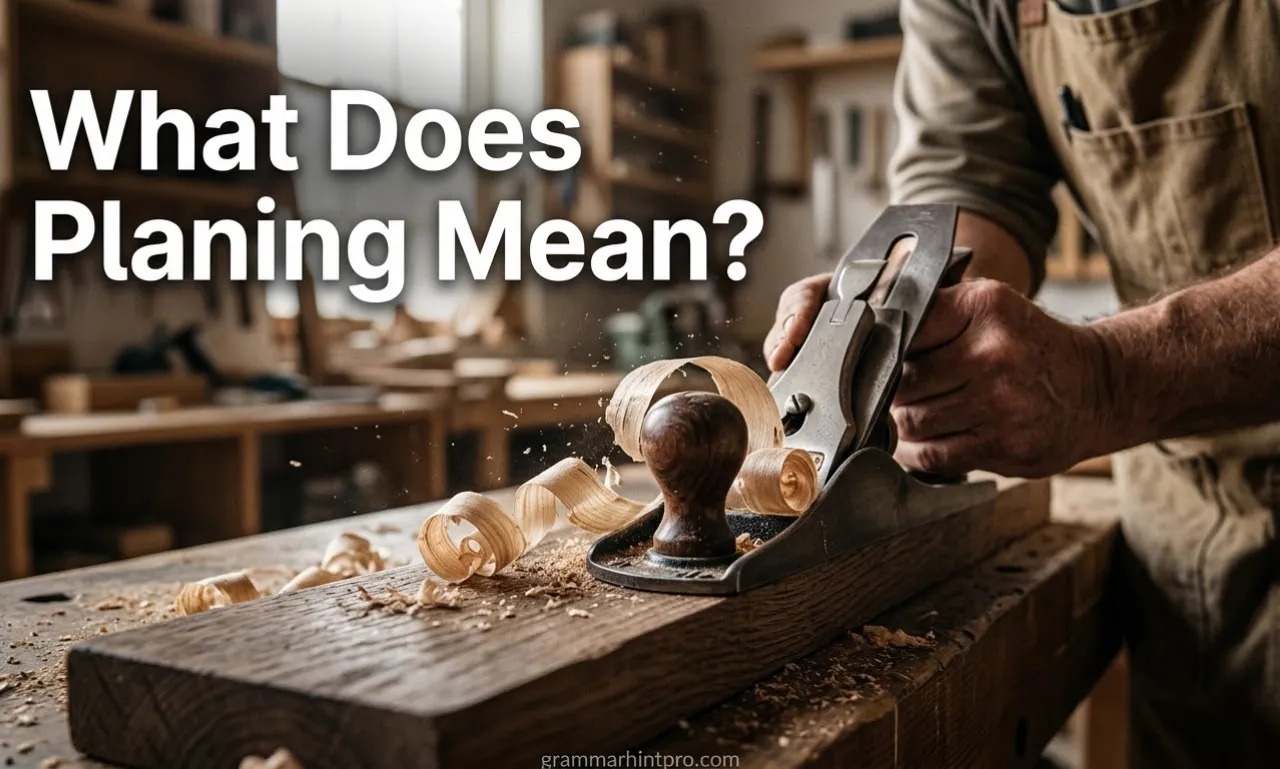
Unlike planning, planing is a specialized word that often appears in woodworking, carpentry, manufacturing, and boating. It comes from the verb plane, which has meanings connected to smoothing a surface or moving across a surface under particular conditions.
The spelling follows a different pattern from planning.
When you add -ing to plane, you normally drop the silent E:
Plane + ing = planing
The base word determines the spelling. You don’t double the N because plane doesn’t end in N; its final E disappears before the suffix.
Planing in Woodworking
In woodworking, planing means removing thin layers of material from a wooden surface to make it smoother, flatter, or more even. A craftsperson may use a hand plane or a powered machine, depending on the job.
A hand plane typically has a sharp blade that shaves a small amount of wood as the tool moves across the surface. With careful control, the worker can remove raised areas, refine an edge, or prepare a board for a better fit.
For example:
- The carpenter is planing the rough wooden board.
- She spent an hour planing the edges of the cabinet door.
- Careful planing helped the craftsman create an even surface.
In these sentences, planning would change the meaning. The carpenter isn’t organizing the board’s future; the carpenter is physically shaping it.
Planing in Manufacturing
Manufacturing uses planing to prepare and shape materials, particularly in metalworking and woodworking operations.
In traditional metalworking, a planing machine moves a cutting tool or workpiece in a controlled, linear motion to remove material from a surface. This process can create flat surfaces and other features, depending on the machine and setup.
Woodworking equipment also performs planing. A power planer can remove material more quickly than a hand tool, making it useful when workers need to process multiple boards or achieve consistent thickness.
The key distinction is that planing describes a physical machining process, not the act of arranging future work.
For instance, a workshop might plan a production schedule on Monday and plane a metal component on Tuesday. The first activity involves organization; the second involves machining.
Planing in Boating
In boating, planing describes a condition in which a boat moves fast enough for hydrodynamic forces to support much of its weight. Instead of displacing water in the same way as a slower-moving hull, the boat rises and skims across the surface.
This behavior depends on several factors, including hull design, speed, load, and water conditions. Not every boat is designed to plane, and the speed required varies with the vessel and its operating conditions.
Consider this sentence:
“The speedboat was planing across the lake.”
Here, planing describes the boat’s motion. Writing “The speedboat was planning across the lake” would suggest that the boat was making arrangements rather than moving over the water.
Is Planing a Verb or a Noun?
Planing can function as both a present participle and a gerund, just as planning can.
As a present participle, it describes an ongoing action:
- The carpenter is planing the tabletop.
- The boat was planing across the water.
As a gerund, it functions as a noun:
- Planing the board took twenty minutes.
- Proper planing can improve the fit of wooden parts.
The grammatical structure resembles that of planning. The difference lies in the base verbs and their meanings.
| Base verb | -ing form | Meaning |
| Plan | Planning | Preparing or organizing |
| Plane | Planing | Smoothing a surface or describing a type of movement |
This distinction explains why both spellings are valid even though you can’t use them interchangeably.
Planing vs. Planning Examples in Everyday and Professional Writing
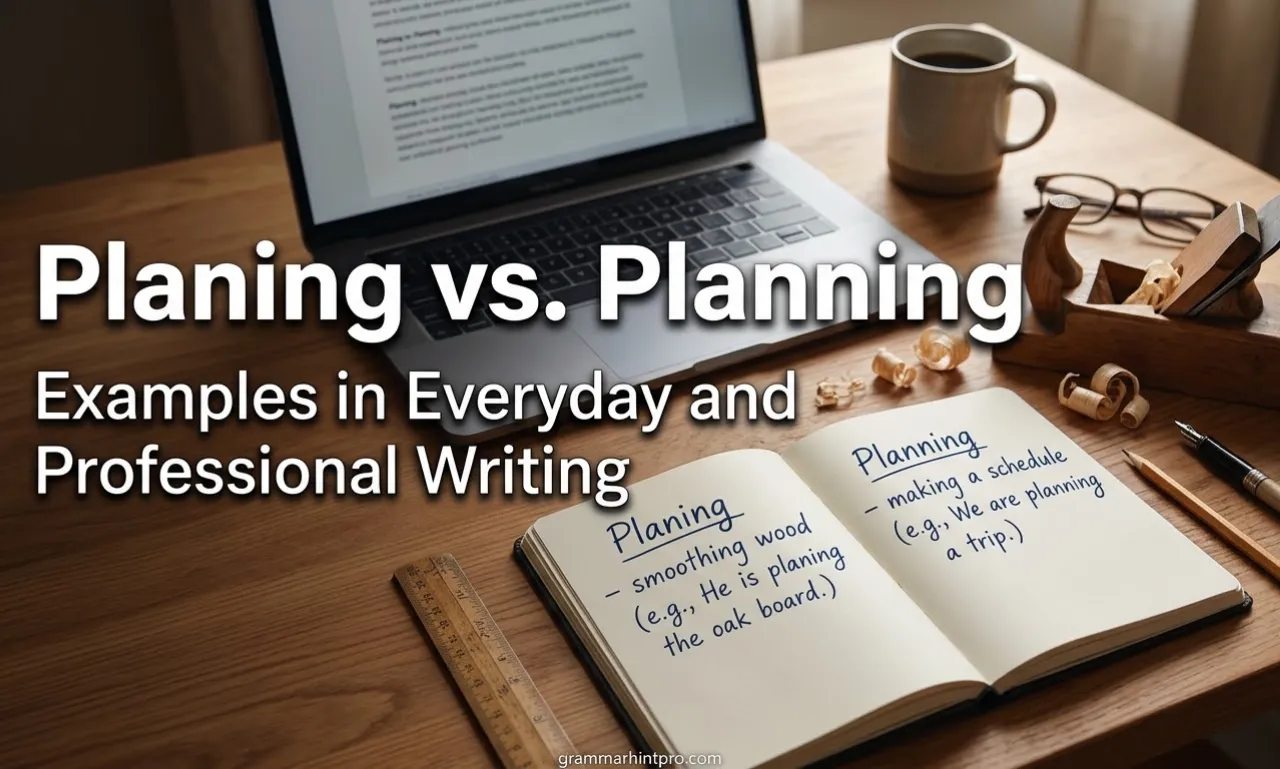
Examples make the difference easier to remember because they show how context determines the correct spelling. The following sentences cover common situations in personal, academic, professional, and technical writing.
Examples of Planning
Use planning whenever you describe preparation, organization, or decisions about future activities.
- Personal life: I’m planning a family dinner for Saturday.
- Education: The students are planning their science project.
- Business: Our team is planning a new marketing campaign.
- Finance: She is planning her monthly budget.
- Travel: We’re planning a road trip across the country.
- Career: He is planning to apply for a management position.
- Events: They’re planning a conference for next spring.
In each example, someone is deciding what to do or organizing future activities.
Examples of Planing
Use planing when the sentence describes smoothing a surface with a plane or a boat moving in a planing condition.
- Carpentry: The carpenter is planing a rough wooden board.
- Furniture making: Planing the tabletop removed its uneven spots.
- Woodworking: The craftsman spent the morning planing hardwood panels.
- Manufacturing: The machine is planing the metal surface.
- Boating: The speedboat was planing across the lake.
- Technical description: The hull design helps the boat reach its planing condition.
These examples involve physical processes rather than the preparation of future activities.
Side-by-Side Comparisons
Sometimes, changing one letter makes a sentence mean something entirely different. Compare these pairs carefully.
| Planning | Planing |
| We’re planning the kitchen renovation. | We’re planing the wooden cabinet doors. |
| She’s planning a new business venture. | She’s planing a wooden panel. |
| The team is planning its next project. | The machine is planing the workpiece. |
| They’re planning a boating trip. | Their speedboat is planing across the water. |
The first column focuses on decisions and preparation. The second describes physical work or a specific type of movement.
Case study: A furniture workshop
Imagine a furniture maker preparing to build a dining table. First, she is planning the project. She chooses the design, estimates the cost, orders supplies, and sets a deadline.
Once the materials arrive, she begins planing the wooden boards to create smooth, even surfaces.
Both words belong in the same project description, but they refer to different activities. Planning organizes the work; planing prepares the material.
Common Mistakes When Using Planing and Planning
The most common error occurs when writers use planing to describe making arrangements. Because both words are valid, a spell-checker may not catch the problem.
Using Planing Instead of Planning
Incorrect: “We’re planing our summer vacation.”
Correct: “We’re planning our summer vacation.”
The sentence describes organizing a trip, so planning is the correct choice.
Here’s another example:
Incorrect: “The company is planing a major expansion.”
Correct: “The company is planning a major expansion.”
The company is preparing for future growth, not smoothing a physical surface.
Using Planning Instead of Planing
The reverse mistake can also occur, especially when someone writes about woodworking.
Incorrect: “The carpenter is planning the edges of the wooden door.”
Correct: “The carpenter is planing the edges of the wooden door.”
In this context, planing describes removing small amounts of wood to smooth the edges.
Assuming Planing Is Always Wrong
Don’t treat planing as a misspelling simply because you encounter it less often. It’s a legitimate word with specific meanings.
For example, “The boat is planing at speed” can be correct in a technical discussion of boat performance. Likewise, a carpenter can describe the process of planing a rough board.
The right approach is to identify the intended action before correcting the spelling.
Relying Entirely on Spell-Check
Spell-checking tools can identify many typing errors, but they don’t always recognize the meaning you intend.
Suppose you write, “I’m planing a meeting with the new client.” Both planing and planning are recognized words, so an automated checker may not flag the sentence.
A simple proofreading question helps: Am I organizing something or physically smoothing a surface?
If you’re arranging a meeting, use planning. If the sentence concerns a plane tool, check whether planing fits the context.
Not sure whether “Vinal” or “Vinyl” is the correct spelling? Check out our guide on Vinal vs. Vinyl to discover their meanings, differences, and correct usage with easy examples.
Easy Ways to Remember Planing vs. Planning
A useful memory trick connects each spelling to its base word. You don’t need several complicated mnemonics when one clear distinction explains the difference.
Planning Has Two N’s
Remember the relationship between plan and planning.
Plan → Planning
When you add -ing to plan, double the final N. This spelling pattern also appears in running, sitting, and stopping.
Think of the double N as a reminder that you’re working with the verb plan.
Planing Comes From Plane
The word planing comes from plane, not plan.
Plane → Planing
Picture a carpenter pushing a hand plane across a wooden board. The tool shaves away thin layers of wood, leaving a smoother surface.
You can also associate planing with a boat skimming across the water. Both meanings describe physical processes rather than organizing future activities.
Use This Simple Decision Guide
Ask yourself what the sentence describes.
For more helpful grammar tips, spelling explanations, and easy-to-understand English lessons, visit Grammar Hint Pro and improve your English skills.
Which Spelling Should You Use?
Are you preparing, organizing, or making arrangements?
Use PLANNING
Example: We’re planning a family reunion.
Are you smoothing a surface with a plane or describing a boat’s planing motion?
Use PLANING
Example: The carpenter is planing a board.
This decision rule works for most everyday spelling questions involving these words. When the context is unclear, look at the verb’s intended meaning and the words surrounding it.
Frequently Asked Questions
Q1. Is it planing or planning?
Both spellings are correct, but they have different meanings. Planning means preparing or organizing something, while planing usually refers to smoothing a surface with a plane or describes a boat moving across the water in a planing condition.
Q2. Is planning spelled with one N or two?
The correct spelling is planning, with two N’s. It comes from the verb plan, which doubles its final consonant before adding -ing.
Q3. Why does planning have two N’s?
The spelling follows the consonant-doubling rule. Because plan ends in a consonant after a short vowel, its final N doubles before the suffix -ing is added.
The result is planning, not planing.
Q4. What does planing mean in woodworking?
Planing is the process of smoothing, flattening, or shaping wood by removing thin layers of material. A craftsperson can perform this task with a hand plane or a powered planer.
Q5. Can planing be used in a sentence?
Yes. For example, “The carpenter spent the afternoon planing the wooden tabletop.” The word is correct because the sentence describes smoothing wood.
Conclusion
The difference between planing vs. planning comes down to the base word and its meaning. Planning comes from plan and refers to preparing, organizing, or deciding what to do. Planing comes from plane and usually describes smoothing a surface or a boat moving across the water in a planing condition.
The spelling rule is straightforward: plan doubles its final N before adding -ing, while plane drops its silent E. That’s why planning has two N’s and planing has one.
Before choosing either word, consider what your sentence actually means. If you’re organizing a meeting, preparing a trip, or arranging a project, use planning. If you’re smoothing a board or describing a boat’s movement, planing may be correct.
Remember: You plan your next step, but a carpenter planes a board. That simple distinction will help you choose the right spelling in everyday conversations, academic assignments, and professional writing.