



When comparing vinal vs. vinyl, one letter makes a difference in meaning. If you’re writing about vinyl records, flooring, plastic materials, or adhesive decals, vinyl is the correct spelling. However, vinal isn’t simply a meaningless typo. It has a rare technical meaning in textile manufacturing and appears in other specialized contexts.
Understanding this distinction helps you avoid spelling mistakes in everyday writing, product descriptions, academic assignments, and professional documents. It also clears up a common misconception: the fact that a word looks unusual doesn’t automatically make it incorrect.
This guide explains the difference between vinal and vinyl, their meanings, pronunciation, practical uses, and correct spelling. You’ll also learn how vinyl relates to PVC, why people confuse these terms, and how to use each word accurately.
Vinal vs. Vinyl at a Glance
The main difference between vinal and vinyl comes down to their meanings and the contexts in which writers use them.
Vinyl is the familiar term for a group of chemical materials and products made from vinyl-based polymers. People commonly use it when discussing records, flooring, siding, upholstery, and signs. Vinal, by contrast, is a rare technical term for a synthetic textile fiber made largely from vinyl alcohol units. It can also refer to certain plants or appear in proper names.
Here’s a quick comparison.
| Feature | Vinyl | Vinal |
| Standard spelling | Yes | Yes, in specific contexts |
| Common meaning | A chemical group, material, or record medium | A specialized synthetic textile fiber |
| Common everyday use | Flooring, records, decals, upholstery | Rarely used in everyday English |
| Industry association | Construction, music, manufacturing, healthcare | Textile and materials science |
| Correct for vinyl flooring? | Yes | No |
| Correct for vinyl records? | Yes | No |
| Can appear as a proper name? | Yes | Yes |
The key point is simple: use vinyl when you mean the familiar material or record medium. Reserve vinal for a verified specialized meaning or an official name that uses that spelling.
Unsure whether to use “Mistakingly” or “Mistakenly” in your writing? Read our guide on Mistakingly or Mistakenly to understand their meanings, differences, and correct usage with clear examples.
What Does Vinyl Mean?

Vinyl has several related meanings, and the intended meaning depends on the context. In everyday English, it most often refers to a plastic material or the material used to manufacture phonograph records.
In chemistry, however, vinyl has a more specific meaning. It refers to a molecular group derived from ethylene, written as CH₂=CH– when represented as a substituent. This group appears in numerous chemical compounds used to manufacture polymers, coatings, adhesives, and plastics.
The word therefore covers more than one product. A vinyl floor, a vinyl record, and a vinyl sign may share a connection to vinyl-based materials, but their manufacturing processes and physical properties can differ considerably.
Vinyl as a Material
Vinyl is widely associated with polyvinyl chloride (PVC), a synthetic thermoplastic used in many commercial and household products. Manufacturers value PVC because they can formulate it in rigid or flexible forms, depending on the intended application.
Rigid PVC works well in products such as pipes, window frames, and construction profiles. Flexible PVC, which typically contains plasticizers, suits applications such as cable insulation, flexible tubing, and some upholstery materials.
Vinyl products can offer several practical advantages:
- Moisture resistance: Many vinyl products work well in environments where ordinary untreated materials could absorb water.
- Versatility: Manufacturers can adjust formulations to produce rigid panels, flexible sheets, films, and coatings.
- Low maintenance: Many vinyl surfaces need only routine cleaning rather than specialized treatment.
- Design flexibility: Vinyl products can feature different colors, textures, finishes, and patterns.
- Manufacturing adaptability: Processors can extrude, mold, coat, or otherwise shape suitable vinyl formulations.
However, these characteristics don’t apply equally to every product marketed as vinyl. Performance depends on the polymer, additives, construction, installation, and intended use.
How Vinyl Is Made
The manufacturing process depends on the specific vinyl material. For common PVC products, production begins with vinyl chloride, a chemical building block that manufacturers polymerize to create polyvinyl chloride.
During polymerization, many small vinyl chloride molecules join to form long molecular chains. The resulting PVC resin then undergoes further processing before it becomes a finished product.
Manufacturers may combine the resin with additives to achieve the required performance. These can include stabilizers, pigments, impact modifiers, processing aids, and plasticizers.
The formulation determines many of the material’s final characteristics. For example, a rigid PVC pipe needs a different formulation from a soft, flexible vinyl sheet.
A simplified manufacturing sequence looks like this:
- Produce vinyl chloride monomer. Manufacturers prepare the chemical feedstock used to make PVC.
- Polymerize the monomer. A controlled reaction produces PVC resin.
- Compound the resin. Manufacturers blend the resin with selected additives.
- Shape the material. Depending on the product, processors use extrusion, molding, coating, or other suitable techniques.
- Finish and inspect the product. Manufacturers check dimensions, appearance, and relevant performance requirements.
This sequence describes common PVC manufacturing, not every material that chemists classify as a vinyl polymer. Other vinyl-based materials can use different monomers and production methods.
Common Uses of Vinyl
Vinyl appears in many products because manufacturers can tailor its properties to different applications. The word often describes the material category rather than one identical formula.
Common examples include:
- Flooring: Vinyl planks, sheets, and tiles used in residential and commercial interiors.
- Construction: PVC pipes, window profiles, siding, and related building products.
- Music: Phonograph records commonly called vinyl records.
- Sign making: Lettering, decals, banners, and adhesive films.
- Automotive products: Seat coverings, trim, protective films, and floor mats.
- Healthcare: Certain medical bags, tubing, and devices made from appropriately formulated materials.
- Consumer goods: Rainwear, flexible coverings, and selected household products.
The precise composition matters, especially in applications involving medical contact, food contact, fire performance, or long-term outdoor exposure. A product’s name alone doesn’t establish that it meets a particular safety or performance standard.
Vinyl Records
Vinyl records are among the best-known products associated with the word. These discs store sound as physical grooves that a record player reads with a stylus.
The term vinyl often serves as shorthand for the records themselves. Someone might say, “I collect vinyl,” even when referring to an entire collection of albums rather than the plastic material alone.
In a typical record-playing system, the stylus follows the groove as the disc rotates. The cartridge converts the resulting mechanical movement into an electrical signal, which the audio system amplifies and plays through speakers.
Here are a few correct examples:
- “I found a vintage jazz album on vinyl.”
- “The store sells new and used vinyl records.”
- “She prefers collecting vinyl instead of buying digital albums.”
In each sentence, vinyl is the accepted spelling. Writing vinal record would be incorrect unless the writer were reproducing an unusual proper name or a source’s exact wording.
Vinyl Flooring
Vinyl flooring uses synthetic materials to create a durable surface for residential and commercial spaces. Depending on the product, manufacturers may supply it as sheets, tiles, or planks.
Some modern vinyl flooring products imitate wood, stone, or ceramic finishes. Their appearance comes from decorative layers and surface treatments rather than the material being genuine hardwood or stone.
Vinyl flooring can appeal to homeowners because it offers a broad range of designs and relatively straightforward routine cleaning. However, water resistance, scratch resistance, dimensional stability, and installation requirements vary by product.
For example, a homeowner might choose vinyl planks for a busy living area because they want the appearance of wood without installing solid hardwood. The right choice still depends on the product specifications, subfloor conditions, moisture exposure, and manufacturer’s instructions.
The spelling remains the same regardless of the format: vinyl flooring, vinyl plank flooring, and vinyl floor tiles.
Vinyl Siding
Vinyl siding is an exterior cladding product commonly made from formulated PVC. It protects the outside of a building and gives the exterior a finished appearance.
Manufacturers produce siding in different colors, profiles, and textures. Some designs imitate traditional wood siding, while others feature smooth or contemporary finishes.
Its appeal often comes from relatively low routine maintenance and resistance to moisture-related deterioration. Nevertheless, vinyl siding isn’t maintenance-free or indestructible. Installation quality, impact damage, temperature changes, and exposure to severe weather can affect its performance.
Correct usage includes phrases such as vinyl siding installation, vinyl siding panels, and vinyl exterior cladding. The spelling vinal siding is incorrect when describing this product.
Vinyl in Crafts and DIY Projects
Crafting provides another familiar example of the word vinyl. Hobbyists and small businesses use adhesive vinyl for lettering, labels, decorative graphics, and custom designs.
Heat-transfer vinyl is another common category. Crafters use suitable heat and pressure to apply it to compatible fabrics, following the material manufacturer’s instructions.
Adhesive vinyl and heat-transfer vinyl serve different purposes. Adhesive vinyl typically sticks to a surface through a pressure-sensitive adhesive, while heat-transfer products bond to compatible materials through a heat-application process.
For instance, a small business might use adhesive vinyl to create a storefront decal and heat-transfer vinyl to personalize a cotton shirt. Both applications use the spelling vinyl, although the materials and application methods differ.
Vinyl in Healthcare
Certain vinyl formulations have medical applications, including selected tubing, fluid-handling products, and medical bags. Manufacturers can tailor appropriate materials for flexibility, clarity, and other required properties.
However, medical suitability depends on the complete formulation and the device’s intended use. A vinyl material suitable for one application isn’t automatically suitable for another.
Healthcare products must meet the relevant regulatory, biocompatibility, and performance requirements for their intended purpose. It’s therefore inaccurate to assume that every vinyl product is safe for every type of medical contact.
This distinction also reinforces the spelling rule: medical tubing described as vinyl uses the same standard spelling as vinyl flooring or vinyl records.
Why Vinyl Is So Popular
Vinyl’s popularity comes from its adaptability. A material family that can be formulated into rigid pipes, flexible films, protective coatings, and decorative surfaces gives manufacturers considerable design freedom.
Cost can also influence material selection, although the final price depends on the product, quality, manufacturing process, installation, and local market conditions.
Vinyl can also reduce some maintenance demands compared with certain alternatives. For example, a suitable vinyl surface may not require the same refinishing routine as an untreated wood surface.
Still, no material is ideal for every application. Heat exposure, ultraviolet radiation, environmental impacts, disposal requirements, and product-specific durability all matter when evaluating vinyl products.
These differences don’t change the spelling, but they help explain why vinyl appears in such a wide range of industries.Are you unsure whether to use “Meating” or “Meeting”? Read our guide on Meating vs. Meeting to understand their meanings, spelling differences, and correct usage with easy examples.
Is Vinal a Real Word?

Yes. Vinal is a real but uncommon English word. The mistake is treating it as an interchangeable spelling of vinyl.
Dictionary sources recognize vinal as a specialized synthetic textile fiber consisting largely of vinyl alcohol units. Dictionary.com also records other meanings, including a thorny South American shrub and an adjective associated with wine.
These definitions are distinct from the everyday meanings of vinyl. They don’t make vinal flooring an acceptable alternative to vinyl flooring.
Why Vinal Is Usually Incorrect in Everyday Writing
Most spelling mistakes occur because writers intend the familiar material-related word but substitute an a for the y.
Consider these examples:
| Incorrect usage | Correct usage |
| Vinal records | Vinyl records |
| Vinal flooring | Vinyl flooring |
| Vinal siding | Vinyl siding |
| Vinal decals | Vinyl decals |
| Vinal upholstery | Vinyl upholstery |
| Vinal lettering | Vinyl lettering |
In every example, the intended meaning points to vinyl, so the spelling should be corrected.
The same rule applies to business communications. A retailer advertising vinal flooring, a contractor quoting vinal siding, or a musician selling vinal records should correct the wording before publishing the material.
A rare dictionary definition doesn’t justify using vinal where the writer means vinyl.
When Vinal Is Correct
There are legitimate situations in which vinal is the right word.
First, it can refer to a synthetic textile fiber. This specialized meaning appears in dictionary and technical references. If you’re discussing textile science or a historical manufacturing document, the word may be entirely appropriate.
Second, vinal can appear in botanical contexts. The word is used for a thorny South American shrub or tree, Prosopis ruscifolia. In this context, it has nothing to do with vinyl records or flooring.
Third, Vinal may be a proper name. A person’s surname, place name, or organization name should retain its verified spelling.
When you encounter vinal in a technical document, don’t automatically replace it with vinyl. Check the surrounding context first. A word processor may flag a specialized term even when the writer has used it correctly.
Vinal vs. Vinyl: Pronunciation and Spelling
The pronunciation of vinyl can contribute to confusion, particularly when someone knows the word through conversation but hasn’t seen it written frequently.
Cambridge Dictionary gives the standard US pronunciation as /ˈvaɪ.nəl/. In an accessible approximation, it sounds like “VY-nuhl,” with the stress on the first syllable.
The first syllable contains the vowel sound heard in my and time. The second syllable has an unstressed vowel, which makes the word sound less distinct when spoken quickly.
However, pronunciation alone doesn’t establish the spelling of every similar-looking word. The rare textile term vinal can also be pronounced similarly, depending on the reference and context.
The safest approach is to connect the spelling to the meaning. If you’re talking about a record, plastic material, flooring, or signage, write vinyl.
Why People Misspell Vinyl as Vinal
Several factors explain this spelling confusion.
Similar pronunciation: When people hear a word without seeing it written, they may guess the spelling from its sounds. Unstressed syllables make this process harder.
Typing mistakes: The letters a and y are close enough in appearance to be confused during hurried writing, particularly when someone doesn’t proofread.
Unfamiliar vocabulary: People who rarely discuss vinyl products may remember the sound but forget the exact spelling.
Search habits: A person who types vinal flooring into a search engine may see results that suggest the intended term is vinyl. Search engines can interpret misspellings, but that doesn’t make those spellings standard.
Autocorrect limitations: Spell-check tools don’t always identify the intended meaning. Their behavior depends on the software, dictionary, language settings, and surrounding text.
The solution is straightforward: learn the standard spelling and check the context before publishing.
How to Use Vinyl Correctly in a Sentence
Knowing the spelling is useful, but seeing it in context makes the distinction easier to remember. The word vinyl can function as a noun or an adjective, depending on how you use it.
As a noun, it can refer to the material itself or to records collectively. As an adjective, it describes something made from vinyl or associated with vinyl materials.
Examples of Correct Vinyl Usage
Here are practical examples from everyday writing, business communication, and technical descriptions.
- Music: “The collector bought three vinyl records from a secondhand shop.”
- Home improvement: “We installed vinyl flooring throughout the basement.”
- Construction: “The contractor replaced the damaged vinyl siding.”
- Crafting: “She cut vinyl lettering for the shop window.”
- Automotive: “The vehicle features black vinyl upholstery.”
- Retail: “Our store sells removable vinyl decals for laptops.”
- Healthcare: “The manufacturer supplies vinyl tubing for a specified medical application.”
Each example uses vinyl because the sentence refers to a familiar material or a product associated with that material.
Examples of Incorrect Vinal Usage
The following sentences contain spelling mistakes because they use vinal when they mean vinyl.
| Incorrect sentence | Correct sentence |
| I bought a vinal record. | I bought a vinyl record. |
| The kitchen has vinal flooring. | The kitchen has vinyl flooring. |
| We ordered new vinal siding. | We ordered new vinyl siding. |
| He designs custom vinal stickers. | He designs custom vinyl stickers. |
| The car has vinal seats. | The car has vinyl seats. |
These examples show why context matters more than appearance. The word vinal isn’t universally wrong, but it doesn’t replace vinyl in these sentences.
Vinyl in Professional and Academic Writing
Spelling accuracy becomes particularly important when you publish product descriptions, write reports, or prepare technical documents. A spelling mistake can confuse readers and make otherwise reliable information look careless.
For example, a product listing titled “Premium Vinal Flooring” may cause shoppers to question whether the seller understands the material. Similarly, a construction quotation that repeatedly uses vinal siding may look less professional than one that uses the correct industry terminology.
Before publishing, check:
- Product names and specifications.
- Technical terms and material descriptions.
- Headings, image captions, and metadata.
- Invoices, proposals, and customer communications.
- Search-focused titles and product category pages.
A quick proofreading pass can catch these mistakes before they reach customers.Want to avoid common spelling mistakes? Check out our detailed guide on Meating vs. Meeting to learn why “Meeting” is the correct spelling for a planned gathering and how to use it properly.
Vinyl vs. PVC: Are They the Same?
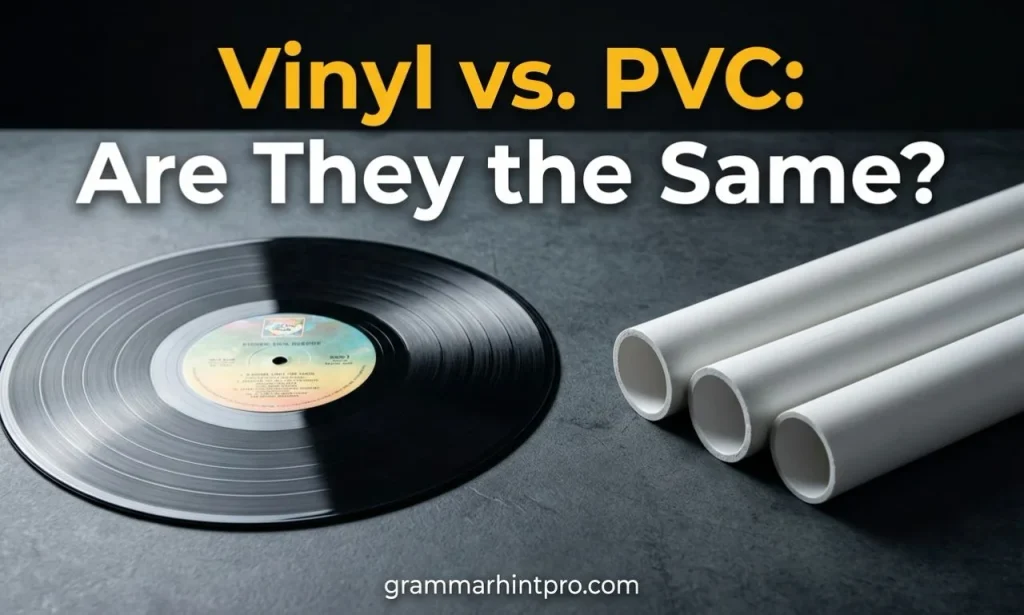
Vinyl and PVC are closely related terms, but they don’t mean precisely the same thing in every context.
PVC stands for polyvinyl chloride, a specific synthetic polymer. In everyday speech, people often use vinyl as a shorter name for PVC or for products made from it.
In chemistry, however, vinyl has a broader meaning. It can refer to the CH₂=CH– molecular group found in vinyl compounds. Several different polymers derive from vinyl-containing monomers, including PVC and polyvinyl acetate.
The following table summarizes the difference.
| Term | Meaning | Example |
| Vinyl | A chemical group or a common name for certain vinyl-based materials | Vinyl flooring |
| PVC | Polyvinyl chloride, a specific polymer | PVC plumbing pipe |
| Vinyl chloride | The chemical monomer used to manufacture PVC | Feedstock for PVC production |
| Polyvinyl acetate | A different polymer made from vinyl acetate | Certain adhesives and coatings |
The distinction matters because material names aren’t always interchangeable. A vinyl product may contain PVC, but the exact composition depends on the product and its formulation.
For everyday spelling, though, the rule stays simple: write vinyl flooring, not vinal flooring. Use PVC when you specifically mean polyvinyl chloride.
Frequently Asked Questions
Q1. Is it vinal or vinyl?
Vinyl is the correct spelling when referring to records, flooring, siding, decals, upholstery, or vinyl-based materials. Vinal is a real but uncommon word with specialized meanings, including a synthetic textile fiber.
Q2. Is vinal a real word?
Yes. Dictionaries recognize vinal as a specialized term for a synthetic textile fiber. It can also refer to a thorny South American plant or appear as a proper name. However, it’s not an accepted alternative spelling of vinyl.
Q3. What is the difference between vinal and vinyl?
The main difference is their meaning. Vinyl commonly refers to a family of materials and products, while vinal has limited technical and botanical uses. Using vinal to describe vinyl flooring or vinyl records is incorrect.
Q4. How do you spell vinyl correctly?
The correct spelling is V-I-N-Y-L. Remember the letter y in the middle of the word. This spelling applies to vinyl records, vinyl flooring, vinyl siding, and other vinyl products.
Q5. Why do people spell vinyl as vinal?
People may confuse the two words because they sound similar in everyday speech. Unfamiliarity with the spelling, typing mistakes, and reliance on autocorrect can also contribute to the error.
Conclusion
The difference between vinal and vinyl is small in spelling but significant in meaning.
Vinyl is the standard word for vinyl-based materials and familiar products such as records, flooring, siding, and decals. Vinal is a legitimate but uncommon word with specialized meanings, including a synthetic textile fiber.
Use this quick reference whenever you’re unsure:
- Writing about records or plastic products? Use vinyl.
- Describing flooring, siding, upholstery, or decals? Use vinyl.
- Reading a technical textile reference that uses vinal? Check the definition before changing it.
- Writing a person’s or organization’s official name? Preserve its verified spelling.
The most important distinction is that vinal isn’t an alternative spelling of vinyl. Once you connect each word to its proper meaning, choosing the correct form becomes easy.
1 thought on “Vinal vs. Vinyl: 7 Powerful Differences You Must Know”