


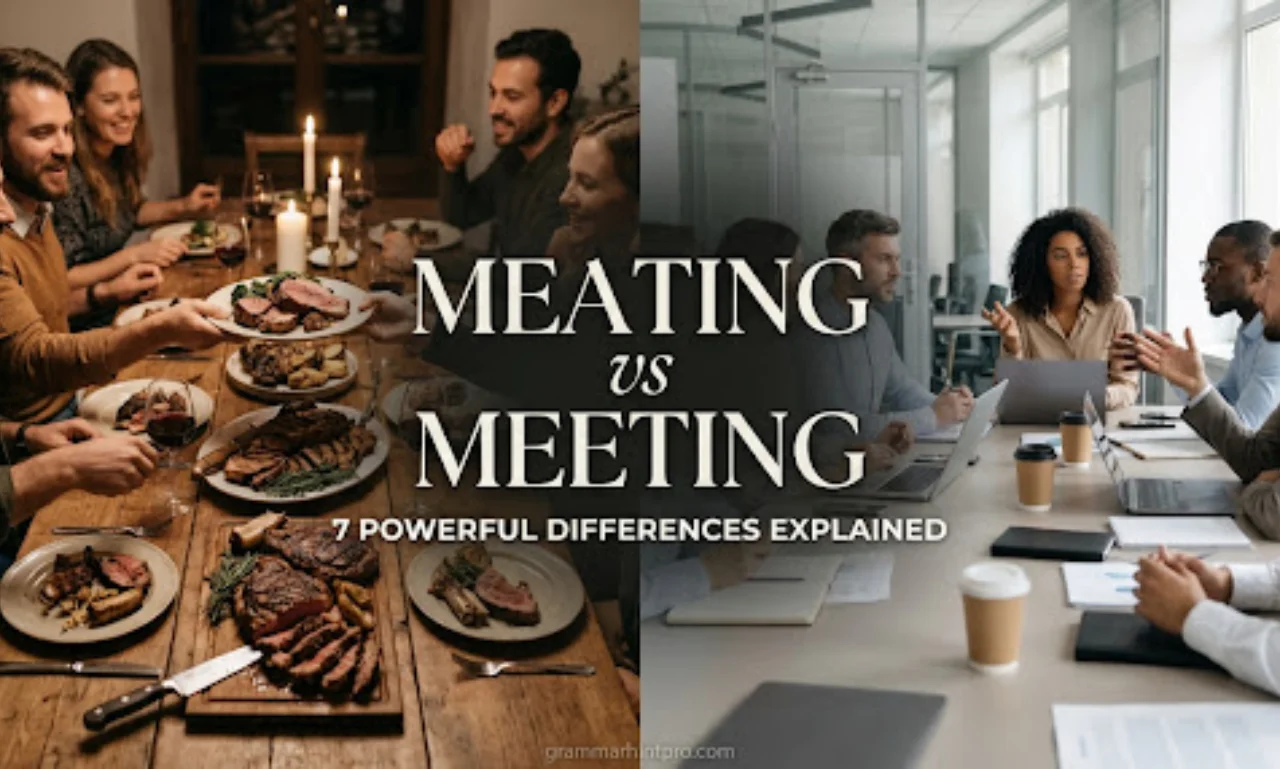
Meating vs meeting looks like a tiny spelling difference, but only one is the standard word you need in ordinary English.
If you’re talking about people coming together, discussing a project, attending a scheduled event, or seeing someone for the first time, the correct spelling is meeting.
The word meating usually appears because someone has confused meet with meat. It can also appear as an intentional wordplay or in unusual contexts, but it isn’t the standard modern spelling for a gathering.
The easiest rule is simple:
Meet + -ing = meeting.
So, if you mean a business gathering, school gathering, social encounter, or the act of meeting someone, choose meeting.
For more helpful grammar tips, spelling explanations, and easy-to-understand English lessons, visit Grammar Hint Pro and improve your English skills.
Meating vs Meeting: The Quick Answer
| Word | Standard modern use | Example |
| Meeting | A gathering, encounter, or form of meet | “The meeting starts at 10 a.m.” |
| Meating | Not the standard spelling for a gathering; may appear as a typo or deliberate wordplay | “We have a meating tomorrow” ❌ |
| Meting | A different word from mete, meaning distributing or dispensing something | “The judge was meting out punishment.” |
Meeting comes from the verb meet. Oxford lists meeting as the -ing form of meet, while its dictionary entry covers several noun meanings, including an organized gathering and an encounter.
The spelling meating comes from inserting the spelling of meat into the word. That’s where the confusion begins.
For example:
- Correct: “I have a meeting with my manager.”
- Incorrect: “I have a meating with my manager.”
- Correct: “We’re meeting the client tomorrow.”
- Incorrect: “We’re meating the client tomorrow.”
There isn’t a British-versus-American spelling difference here. Meeting is the standard spelling in both varieties of English.
Confused about whether to write “Laid Out” or “Layed Out”? Check out our guide on Laid Out vs. Layed Out to learn the correct spelling, meaning, and usage with practical examples.
Wondering whether “Holliday” or “Holiday” is the correct spelling? Check out our guide on Holliday vs. Holiday to learn the correct spelling, meaning, and usage with easy examples.
What Does “Meeting” Mean?

The word meeting has several closely related meanings. Its most common meaning is an occasion when people come together to discuss something, make decisions, exchange information, or work toward a shared goal.
Oxford defines a meeting as an occasion when people come together to discuss or decide something. It also recognizes meeting for an arranged or accidental encounter between people.
That gives us two major everyday meanings.
Meeting as a Noun
As a noun, meeting can describe a planned gathering:
- “The staff meeting begins at nine.”
- “We scheduled a meeting with the client.”
- “The committee held a meeting yesterday.”
- “The meeting lasted almost two hours.”
It can also describe an encounter:
- “Our first meeting was memorable.”
- “It was a chance meeting.”
- “Their meeting changed the course of the project.”
The noun can refer to something highly formal, such as a board meeting, or something fairly casual, such as a meeting between two friends.
Meeting as a Form of “Meet”
Meeting also functions as the present participle of meet.
Oxford gives meeting as the -ing form of meet. The verb meet can mean coming together by arrangement, encountering someone by chance, being introduced to someone, or coming together formally for discussion.
Examples include:
- “I’m meeting Sarah after work.”
- “They are meeting the new director tomorrow.”
- “We are meeting to discuss the budget.”
- “She enjoys meeting new people.”
This distinction matters because not every use of meeting refers to an actual meeting event.
Consider these two sentences:
“The meeting starts at 2 p.m.”
Here, meeting is a noun.
“I’m meeting David at 2 p.m.”
Here, meeting is part of the verb phrase.
The spelling stays the same because both uses come from meet.
What Does “Meating” Mean?
Here’s where the issue gets more complicated.
In ordinary modern English, meating isn’t the standard word for a gathering or an encounter. If you write “meating” when you mean “meeting,” readers will normally understand it as a spelling error.
Major learner-dictionary sources clearly establish meeting as the standard form derived from meet. Oxford lists meeting as the -ing form of meet, while Cambridge likewise gives meeting as the relevant verb form.
Meanwhile, Cambridge treats meat as a noun referring to the flesh of an animal used as food.
That creates the basic contrast:
meet → meeting
meat → meat-related vocabulary
The spelling meating can occasionally appear online as an intentional formation, brand name, joke, or other creative use. Search results also show examples of MEATing being used as a business or restaurant name.
Those examples don’t turn meating into the normal spelling of meeting.
That’s an important distinction. A word can appear somewhere without becoming standard English.
Is “Meating” Actually a Real Word?
The safest answer is: not as the ordinary modern word for a gathering or the -ing form of meet.
That doesn’t mean every occurrence of meating is meaningless. English allows people to create new words, play with existing words, form brand names, and revive unusual expressions. The internet contains plenty of such formations.
However, context matters.
If an email says:
“Let’s schedule a meating for Friday.”
the intended word is almost certainly meeting.
If a restaurant calls itself MEATing, that’s different. The capitalization and context can signal deliberate wordplay involving meat.
This is why simply asking, “Does this sequence of letters exist somewhere?” isn’t enough to determine whether a word is appropriate.
A better test is:
Is this the standard word that educated readers expect in this context?
For a gathering, discussion, appointment, or encounter, the answer is meeting.
Why People Confuse Meating and Meeting
The error isn’t surprising. English gives writers several reasons to mix these forms up.
They Sound the Same
In standard English pronunciation, meet and meat are homophones. Oxford explicitly lists meat and meet together as homophones.
That means you can hear:
“We have a meeting tomorrow.”
but you can’t determine from sound alone whether the writer will spell the base word meet or mistakenly think of meat.
English has many similar pairs:
- meet / meat
- right / write
- sea / see
- flower / flour
- pair / pear
Pronunciation tells you how a word sounds. It doesn’t always tell you how to spell it.
The Words Differ by Only One Letter
Visually, the difference is tiny:
meeting
meating
The second word replaces one of the e’s with a.
When someone types quickly, that one-letter change can slip through unnoticed.
Typing Errors Happen Fast
A writer may know perfectly well that meeting is correct and still type meating.
This becomes especially likely when someone is writing quickly on a phone, responding to messages, or preparing several emails at once.
The brain often focuses on meaning rather than inspecting every letter individually.
Autocorrect Doesn’t Always Help
Spell-checking tools are useful, but they aren’t a substitute for understanding context.
A writing tool may identify a strange spelling. It may also miss an error depending on its dictionary, language settings, or surrounding text.
More importantly, many spelling errors involve a real word replacing the intended word. For example, their and there are both valid words, yet one can still be wrong in a particular sentence.
That same principle explains why proofreading remains valuable.
Lack of Familiarity Creates Problems
English learners often build vocabulary through sound before they fully master spelling.
Someone may know what a “meeting” is without consciously connecting it to the verb meet.
Once that connection becomes clear, the spelling becomes much easier:
meet → meeting
If you often get confused by similar-looking English words, check out our detailed guide on Shining vs. Shinning to understand their meanings, spelling differences, and correct usage.
How “Meeting” Works Grammatically
The word meeting is more flexible than it first appears.
“Meeting” as a Noun
A noun names the event or occasion.
Examples:
- “The meeting is at noon.”
- “Our team has three meetings this week.”
- “The meeting ended early.”
- “She attended a meeting with the director.”
It can take ordinary noun modifiers:
- team meeting
- staff meeting
- board meeting
- project meeting
- parent meeting
- committee meeting
- public meeting
- online meeting
Oxford’s entry includes collocations such as board meeting, committee meeting, public meeting, meeting room, and meeting minutes.
“Meeting” as a Gerund
A gerund is an -ing form that functions grammatically like a noun.
For example:
“Meeting new people can be difficult.”
Here, meeting new people acts as the subject of the sentence.
More examples:
- “Meeting clients takes preparation.”
- “Meeting deadlines requires planning.”
- “Meeting new colleagues can feel awkward.”
- “Meeting people from different cultures can broaden your perspective.”
In these sentences, meeting doesn’t name a scheduled gathering. It names an activity.
“Meeting” as a Present Participle
The same form also appears in progressive verb constructions:
“She is meeting the client tomorrow.”
Here, is meeting forms the verb phrase.
Other examples include:
- “They are meeting at the station.”
- “We are meeting the research team later.”
- “He is meeting his professor after class.”
- “The committee is meeting this afternoon.”
This is another reason meeting cannot be treated as only a noun.
Common Meanings and Uses of “Meeting”
The word covers more territory than a conference room.
An Organized Gathering
This is the most familiar use.
Examples include:
- business meetings
- school meetings
- committee meetings
- public meetings
- board meetings
- community meetings
The purpose might involve discussion, planning, decision-making, reporting, or coordination.
An Encounter
A meeting doesn’t have to be formal.
“It was a chance meeting.”
That means the people encountered each other unexpectedly.
Oxford specifically recognizes meeting as a situation where two or more people meet by arrangement or by chance.
A Coming Together
The word can also describe a broader coming together.
For example:
- “Their first meeting was tense.”
- “The meeting of the two groups created new opportunities.”
- “The river’s meeting with the sea creates a striking landscape.”
This broader sense comes from the underlying idea of things or people coming together.
Unsure whether to use “Mistakingly” or “Mistakenly” in your writing? Read our guide on Mistakingly or Mistakenly to understand their meanings, differences, and correct usage with clear examples.
Are you unsure whether to use “Meating” or “Meeting”? Read our guide on Meating vs. Meeting to understand their meanings, spelling differences, and correct usage with easy examples.
Meeting Examples in Real Sentences
Workplace Examples
- “The sales meeting starts at 9 a.m.”
- “Please send the meeting agenda before Friday.”
- “We need to postpone the meeting.”
- “She scheduled a meeting with the client.”
- “The team discussed the issue during the meeting.”
School Examples
- “The teachers have a staff meeting this afternoon.”
- “The student council held a meeting.”
- “I have a meeting with my academic adviser.”
- “The parents’ meeting begins at six.”
Personal-Life Examples
- “I’m meeting my cousin for lunch.”
- “It was nice meeting you.”
- “We first met at college.”
- “Their chance meeting led to a lasting friendship.”
Online Examples
- “The virtual meeting starts at 3 p.m.”
- “Please join the meeting using the link.”
- “The online meeting was recorded.”
- “She couldn’t attend the video meeting.”
Notice how meeting works naturally in every setting. The context changes, but the spelling doesn’t.
“Meating” Examples: When You May Encounter It
The safest approach is not to invent ordinary definitions for meating.
Instead, recognize the contexts in which you might encounter the spelling.
As a Typographical Error
“The department has a meating tomorrow.”
The intended word is almost certainly meeting.
As Wordplay
Someone discussing food might deliberately create a pun such as:
“We’re having a MEATing this weekend.”
That could be a playful reference to a meat-centered gathering.
Such a formation is creative language, not standard spelling.
As a Name or Brand
A business may deliberately use MEATing as a name because the spelling evokes both meat and meeting. Search results provide examples of MEATing used as a restaurant name.
That is a proper-name choice.
It doesn’t mean you should write meating in a business email.
Meating vs Meeting: Common Spelling Mistakes

The difference becomes clearer when you put the words into actual sentences.
| Incorrect | Correct |
| “The meating starts at 10.” | “The meeting starts at 10.” |
| “We have a meating tomorrow.” | “We have a meeting tomorrow.” |
| “She is meating the client.” | “She is meeting the client.” |
| “Please attend the staff meating.” | “Please attend the staff meeting.” |
| “The meating was canceled.” | “The meeting was canceled.” |
| “I look forward to meating you.” | “I look forward to meeting you.” |
The last example is especially important.
“I look forward to meeting you” is a standard expression. The word meeting functions as a gerund after the preposition to.
That’s why changing it to meating creates a visible spelling error.
Don’t Confuse “Meeting” With “Meting”
There’s another word that deserves attention: meting.
It looks similar to meeting, but it comes from a completely different verb.
Meting comes from mete, which means to distribute or administer something, especially punishment or justice.
For example:
“The judge was meting out punishment.”
So the three forms can be separated like this:
| Word | Base word | Meaning |
| Meeting | meet | Coming together |
| Meating | meat | Not the standard word for a gathering |
| Meting | mete | Distributing or administering something |
This distinction can save you from another common spelling trap.
If you’re writing about a court imposing punishment, meting may be the word you need.
If you’re writing about people getting together, meeting is the answer.
If you’re unsure about the correct spelling, read our guide on Natzi or Nazi to understand the correct spelling, meaning, and usage of the word.
Meating vs Meeting in Professional Writing
Professional writing leaves little room for spelling confusion.
A sentence such as:
“Let’s schedule a meating with the client.”
looks like a basic typo. That may seem minor, but small errors can undermine an otherwise polished email.
Use meeting in:
- business emails
- calendar invitations
- proposals
- reports
- meeting minutes
- internal documents
- client communications
- presentations
- project plans
Common professional phrases include:
- schedule a meeting
- attend a meeting
- hold a meeting
- arrange a meeting
- cancel a meeting
- postpone a meeting
- join a meeting
- meeting agenda
- meeting minutes
- meeting room
Oxford lists many of these as standard meeting collocations.
Confused about whether to write “Laid Out” or “Layed Out”? Check out our guide on Laid Out vs. Layed Out to learn the correct spelling, meaning, and usage with practical examples.
Meating vs Meeting in Academic Writing
Academic writing requires the same standard spelling.
Use meeting when referring to:
- faculty meetings
- research meetings
- department meetings
- student meetings
- academic advising meetings
- conference meetings
- committee meetings
Examples:
“The research team held a meeting to review the results.”
“Students are meeting with their advisers next week.”
“The committee meeting lasted approximately one hour.”
Academic writing also frequently uses meeting as a gerund:
“Meeting the eligibility criteria is necessary for inclusion.”
Notice that this sentence has nothing to do with a scheduled gathering. The word still comes from meet, which here means satisfying or fulfilling a condition.
Oxford lists meet with meanings such as satisfying requirements, meeting targets, meeting demand, and meeting deadlines.
American English vs British English: Is There a Difference?
There is no American-versus-British spelling difference between meeting and meating.
Both American and British English use meeting.
Oxford’s American English entry gives meeting as the standard noun for an occasion when people come together.
British English has some additional uses of meeting. For example, Oxford notes that meeting can refer to certain sports events, such as an athletics meeting or race meeting.
But that doesn’t change the spelling.
Compare genuine regional spelling differences:
- American color / British colour
- American center / British centre
- American organize / British organise
There is no comparable meeting/meating split.
If someone tells you that meating is the British spelling of meeting, that’s incorrect.
Common Phrases With “Meeting”
Learning common phrases can reinforce the correct spelling.
Business and Workplace Phrases
- schedule a meeting
- attend a meeting
- hold a meeting
- arrange a meeting
- call a meeting
- chair a meeting
- join a meeting
- cancel a meeting
- postpone a meeting
- meeting agenda
- meeting minutes
- meeting room
These combinations appear naturally across professional English. Oxford specifically lists verbs such as schedule, convene, arrange, organize, and call with meeting.
Social and Everyday Phrases
- nice meeting you
- meeting someone new
- a chance meeting
- our first meeting
- a meeting with a friend
- meeting people
- meeting for lunch
The expression “Nice meeting you” is particularly common when ending an interaction with someone you’ve just met.
Digital and Remote-Work Phrases
Modern communication has expanded the range of meeting vocabulary:
- virtual meeting
- online meeting
- video meeting
- meeting link
- meeting invite
- meeting platform
- meeting recording
- meeting chat
Oxford’s current entry explicitly includes virtual meetings and videoconferencing examples.
Wondering whether “Pricy” or “Pricey” is the correct spelling? Check out our guide on Pricy vs. Pricey to learn their meanings, spelling differences, and how to use them correctly in everyday writing.
Meeting vs Other Related Words
Understanding neighboring words can make the distinction even clearer.
Meeting vs Appointment
An appointment usually emphasizes a scheduled time with a person or service.
A meeting usually emphasizes people coming together for interaction, discussion, or a shared purpose.
For example:
- “I have a doctor’s appointment.”
- “I have a meeting with the project team.”
The terms can overlap in some situations, but they aren’t always interchangeable.
Meeting vs Conference
A conference is generally larger or more formal than an ordinary meeting.
A company might hold a short team meeting every Monday but organize an annual conference for hundreds of employees.
Meeting vs Gathering
Gathering is broader.
A gathering may involve socializing without a formal agenda. A meeting often suggests some specific purpose, although not always.
Meeting vs Session
A session often refers to a period devoted to a particular activity.
For example:
- training session
- therapy session
- study session
- question-and-answer session
A meeting can contain a session, but the words aren’t identical.
Easy Ways to Remember “Meeting” Is Correct
Remember “Meet” → “Meeting”
The most reliable trick isn’t a clever mnemonic. It’s remembering the word family:
meet → meeting
The verb already contains the spelling you need.
Don’t Let “Meat” Fool You
Keep the meanings separate:
meat = food
meet = come together
Therefore:
meeting = coming together
You wouldn’t normally say:
“We are meating our new client.”
The client isn’t food. You’re meeting the client.
Use the Meaning Test
Before typing the word, ask:
Am I talking about people coming together?
If yes, use meeting.
This works for nearly every ordinary situation:
- meeting a friend
- meeting a client
- meeting a teacher
- attending a meeting
- scheduling a meeting
- joining a meeting
For more helpful grammar tips, spelling explanations, and easy-to-understand English lessons, visit Grammar Hint Pro and improve your English skills.
A Simple Meating vs Meeting Memory Diagram
MEET
│
▼
MEETING
│
┌─────────┴─────────┐
▼ ▼
A gathering The act of
or encounter coming together
MEAT
│
▼
Food / animal flesh
│
▼
Not the normal source
of the word “meeting”
One more word belongs nearby:
METE
│
▼
METING
│
▼
Distributing or
administering something
The diagram captures the central point: similar spelling doesn’t mean shared meaning.
Case Study: A Small Typo That Changes the Impression
Imagine a project manager sends this email:
“Let’s schedule a meating with the design team for Thursday.”
Everyone can probably understand the intended meaning.
The problem isn’t comprehension. It’s credibility.
The recipient sees an obvious spelling mistake in a sentence that should be straightforward. If the message goes to a client, senior executive, professor, or hiring manager, that small error can make the writer appear less careful.
Now compare:
“Let’s schedule a meeting with the design team for Thursday.”
The second version disappears into the background. That’s exactly what good spelling should do. It lets the reader focus on the message rather than the mistake.
This is why correct spelling matters most in contexts where precision carries weight.
A single incorrect letter can turn a polished sentence into something that looks unfinished.
Why Correct Spelling Matters
Spelling isn’t merely about following rules for the sake of rules.
It helps readers interpret your meaning quickly.
The distinction between meet, meat, and mete demonstrates how English spelling preserves meaning even when pronunciation overlaps.
Consider:
- meet → come together
- meat → animal flesh used as food
- mete → distribute or administer
Their forms look different because their meanings and histories differ.
Cambridge defines meat as animal flesh used as food, while Oxford identifies meet as the verb behind meeting and documents its many senses.
In professional and academic writing, the safest choice is therefore straightforward: use the established word your readers expect.
Frequently Asked Questions About Meating vs Meeting
Q1. Is “meating” a correct spelling of “meeting”?
No. Meeting is the standard spelling when you mean a gathering, encounter, or the act of coming together. Meating may appear as a typo, wordplay, or unusual formation, but it isn’t the normal spelling of meeting.
Q2. Is “meating” a real word?
It can appear in specialized, creative, historical, or proper-name contexts. However, it isn’t the standard modern English word for a gathering. In ordinary writing, use meeting.
Q3. Why do people confuse “meating” and “meeting”?
The main reason is pronunciation. Meet and meat are homophones, meaning they have the same pronunciation but different spellings and meanings. When someone adds -ing, they may accidentally write meating instead of meeting.
Q4. Is “meating” the British spelling of “meeting”?
No. Meeting is the standard spelling in both American and British English. This isn’t a US-versus-UK spelling difference.
Q5. What is the correct spelling: meeting or meating?
Use meeting when you mean a gathering, discussion, encounter, or the act of meeting someone.
Example: “We have a meeting with the client tomorrow.”
Conclusion
The difference between meating vs meeting comes down to one small letter, but the meanings are completely different.
When you mean a gathering, discussion, encounter, or the act of coming together, meeting is the correct spelling. It comes from the verb meet, as in meet → meeting.
Meating isn’t the standard modern spelling of meeting. You may see it in a typo, a pun, a brand name, or an unusual context involving the word meat. However, those uses don’t make it an acceptable replacement for meeting in everyday, professional, or academic writing.
The easiest way to remember the difference is to connect the word with its base form:
Meet → Meeting
So, if you’re scheduling a business meeting, meeting a friend, joining an online meeting, or writing “nice meeting you,” always choose meeting.
9 thoughts on “Meating vs Meeting: 7 Powerful Differences Explained”