


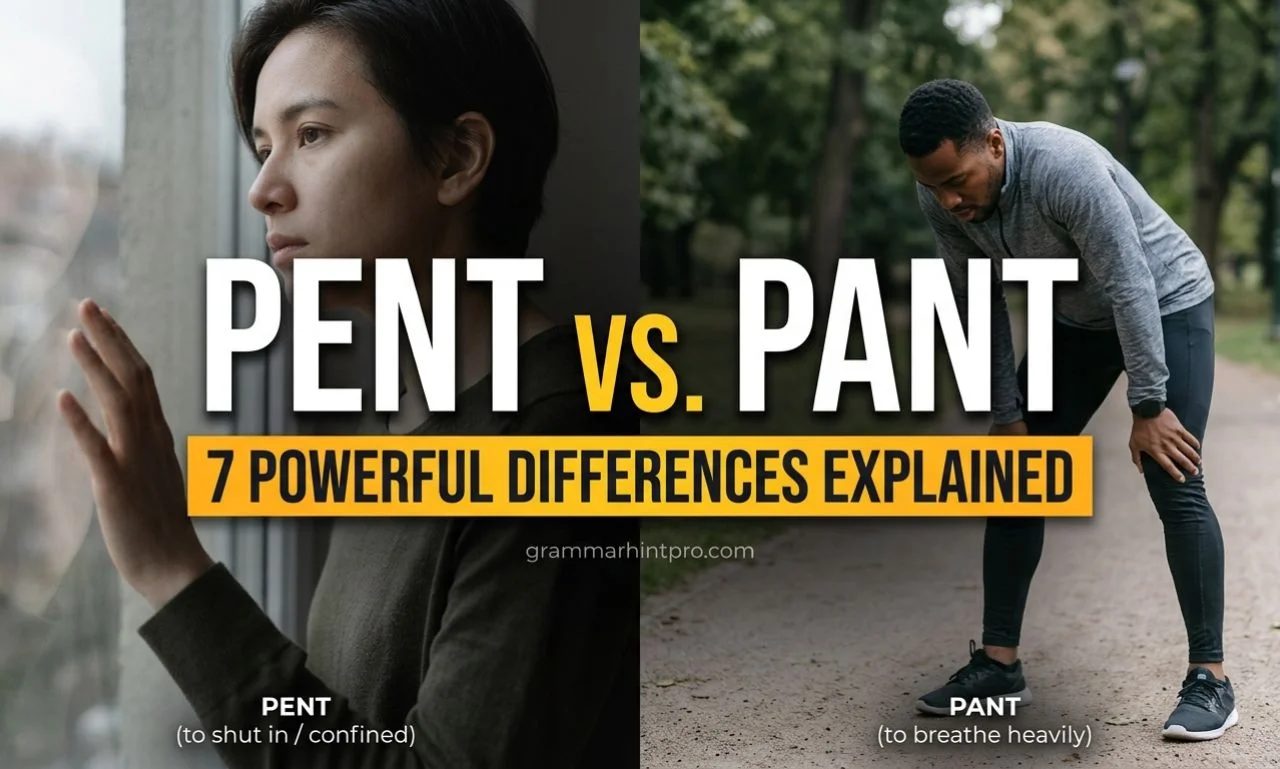
If you confuse pent and pant, you’re dealing with two words that look almost identical but describe completely different ideas. Pent relates to something being confined, restrained, or held back, while pant means to breathe quickly and heavily.
The confusion becomes especially common with pent-up, a phrase used for emotions, energy, tension, and even consumer demand. Meanwhile, pant usually describes a physical action, such as breathing heavily after running.
The easiest distinction is simple:
Pent = held in.
Pant = breathe heavily.
Once you understand that basic contrast, the rest falls into place. This guide explains the meanings, grammar, pronunciation, common expressions, real-world uses, and frequent mistakes involving pent vs. pant.
Pent vs. Pant: The Quick Difference
The two words differ by only one vowel, but their meanings have little in common.
| Word | Main meaning | Common use | Example |
| pent | confined, restrained, or held in | pent-up emotions | He released his pent-up anger. |
| pant | to breathe quickly and heavily | exercise, heat, fear | She began to pant after the race. |
Pent is most familiar as part of pent-up, an adjective describing something that has been contained rather than expressed or released. Cambridge defines pent-up as describing feelings that have not been expressed or released.
Pant, by contrast, is a verb meaning to breathe quickly and loudly through the mouth, often after strenuous activity.
So if someone has pent-up frustration, that frustration has been held inside.
If someone is panting after a sprint, they’re breathing rapidly.
The Simple Difference
Think about the direction of the action.
With pent, something stays inside:
- pent-up anger
- pent-up frustration
- pent-up energy
- pent-up demand
With pant, something happens through breathing:
- pant after running
- pant from the heat
- pant for breath
- pant heavily
A useful mental picture makes the distinction easier. Pent suggests a pressure cooker with the lid closed. Pant suggests a runner trying to catch their breath.
That contrast captures the basic difference better than memorizing two dictionary definitions.
Are you unsure whether to use “Meating” or “Meeting”? Read our guide on Meating vs. Meeting to understand their meanings, spelling differences, and correct usage with easy examples.
What Does “Pent” Mean?

Pent is a real English word, although most people encounter it in the expression pent-up rather than as an everyday standalone word.
The word can function as the past tense or past participle of pen when pen means to confine or enclose. In other words, something that has been confined can be described as pent.
For modern readers, however, the most useful form to recognize is pent-up.
Pent as a Word Related to Confinement
The underlying idea is containment.
When something is pent, it has been kept within limits rather than allowed to escape freely. That idea works especially well with emotions and forces.
For example:
- The argument released years of pent frustration.
- The speech brought his pent anger to the surface.
- The children had plenty of pent energy after spending the day indoors.
These constructions are grammatically possible, but modern English strongly favors pent-up in many such contexts.
That’s why pent-up anger sounds much more natural than pent anger in ordinary conversation.
What Does “Pent-Up” Mean?
Pent-up describes something that has accumulated because it hasn’t been expressed, released, or acted upon.
Cambridge gives examples involving pent-up anger and frustration, while its business definition uses the term for demand that has not yet been expressed through sales.
The idea is essentially:
Pressure builds → release is delayed → pressure remains contained → eventual release becomes possible.
That pattern applies to both physical and figurative situations.
For example:
After months of working without a break, she had a lot of pent-up frustration.
The frustration existed before the moment of expression. It had simply remained contained.
The same principle applies to:
- pent-up anger
- pent-up resentment
- pent-up excitement
- pent-up energy
- pent-up emotion
- pent-up demand
Examples of “Pent” and “Pent-Up”
Here are natural examples:
- He finally expressed his pent-up anger.
- The children ran outside to burn off their pent-up energy.
- She had years of pent-up resentment toward her former employer.
- The conversation gave him a chance to release some pent-up frustration.
- The market experienced pent-up demand after consumers delayed purchases.
Notice the recurring idea: something accumulated because normal release or expression was delayed.
That’s the semantic core of pent-up.
Why “Pent-Up” Is So Common
The phrase pent-up is much more common in contemporary English than standalone pent.
That’s important because learners sometimes see pent-up and assume pent works like an ordinary adjective in every situation. It doesn’t.
You can usually think of pent-up as a fixed and productive expression. It naturally modifies things that can be contained, suppressed, delayed, or accumulated.
Common Collocations With Pent-Up
Some combinations appear far more naturally than others.
| Common phrase | Meaning |
| pent-up anger | anger that hasn’t been expressed |
| pent-up frustration | accumulated frustration |
| pent-up resentment | resentment kept inside |
| pent-up emotion | feelings that haven’t been released |
| pent-up energy | unused or accumulated energy |
| pent-up demand | demand delayed or suppressed by circumstances |
| pent-up excitement | excitement that has been building |
These collocations also show why context matters. Pent-up demand isn’t about someone’s emotions. It’s an economic concept.
What Does “Pant” Mean?
Pant has a completely different meaning.
As a verb, to pant means to breathe rapidly and heavily, usually with the mouth open. Cambridge describes it as breathing quickly and loudly through the mouth, often after energetic activity.
For example:
The runner began to pant after climbing the hill.
Here, pant describes an observable physical action.
The word can appear in several grammatical forms:
- pant — present/base form
- pants — third-person singular
- panted — past tense
- panting — present participle
Examples:
- I pant after intense exercise.
- The dog pants in the heat.
- He panted after sprinting across the field.
- She was panting when she reached the finish line.
Pant as a Figurative Expression
Pant can also express intense longing.
The phrasal verb pant for or pant after someone or something means to desire that person or thing strongly. Cambridge lists both forms as phrasal verbs.
For example:
The poet panted for freedom.
This use is more literary than ordinary physical pant. In everyday American English, you are far more likely to encounter pant in descriptions of heavy breathing.
Why Do People Pant?
Panting usually appears when the body needs to manage increased physical demand.
After vigorous exercise, your breathing becomes faster because your muscles have increased their demand for oxygen and produced more carbon dioxide. Rapid breathing helps exchange gases more quickly.
That’s why someone may pant after running, climbing stairs, cycling, or playing an intense sport.
You might see this sequence:
Exercise → increased metabolic demand → faster breathing → panting
Panting can also occur during strong emotional states. Fear, anxiety, excitement, and stress can affect breathing patterns.
For example:
The dog started to pant when the fireworks began.
The word still refers to breathing. The trigger simply isn’t physical exercise.
Why Do Dogs Pant?
Dogs provide one of the clearest real-world examples of pant.
Unlike humans, dogs rely heavily on panting to regulate body temperature. Moisture evaporates from the tongue and respiratory surfaces as the dog rapidly moves air through its mouth and airways. That evaporation helps dissipate heat.
Dogs also sweat through their paw pads, but sweating plays a much smaller role in whole-body cooling than it does in humans. Panting is their primary cooling mechanism.
Panting as a Cooling Mechanism
Imagine a dog returning from a long run on a warm afternoon.
Its body has generated heat. The dog opens its mouth, extends its tongue, and begins breathing rapidly.
That’s panting.
The rapid airflow helps moisture evaporate from the mouth and upper respiratory tract. That evaporation contributes to cooling.
Panting can therefore be completely normal after:
- exercise
- running
- playing
- warm-weather activity
- excitement
- brief stress
The important factor is context.
A dog panting after chasing a ball is very different from a dog panting heavily while resting in a cool room.
When Excessive Panting Matters
Unusual panting can sometimes indicate overheating, pain, anxiety, respiratory problems, or another medical issue. Veterinary sources recommend paying attention when panting doesn’t fit the situation or occurs alongside other concerning symptoms.
That distinction doesn’t change the vocabulary lesson, but it gives pant a useful real-world context:
The dog is panting.
Not:
The dog is pent.
The second sentence changes the word completely and doesn’t describe the dog’s breathing.
Confused about the difference between measuring something and describing its qualities? Read our guide on Quantify vs. Qualify to understand their meanings, differences, and correct usage with practical examples.
Pent vs. Pant: Pronunciation Differences
Pent and pant sound different in American English because their vowel sounds differ.
- pent: /pɛnt/
- pant: /pænt/
The final consonants are the same: p-n-t.
The crucial difference is the vowel.
Pent uses the vowel sound found in words such as bed and sent. Pant uses the vowel found in cat and hand for many American English speakers.
Pronunciation Tip
Say these pairs slowly:
- pent — pant
- sent — sand
- bed — bad
- met — mat
The vowel shift becomes easier to hear when you compare familiar words.
This matters because the spelling difference is tiny. In fast speech, especially for English learners, the words can blur together.
When writing, however, the context usually makes the correct choice obvious.
Pent vs. Pant: Side-by-Side Comparison

The fastest way to understand pent vs. pant is to compare their jobs in a sentence.
| Feature | Pent | Pant |
| Core idea | confinement or restraint | rapid, heavy breathing |
| Common form | pent-up | pant, panting, panted |
| Typical subject | emotion, energy, demand | person, animal |
| Common context | suppressed feelings | exercise or heat |
| Example | pent-up frustration | pant after running |
| Pronunciation | /pɛnt/ | /pænt/ |
| Common phrase | pent-up demand | pant for breath |
Quick Rule
Use pent when something is contained or held back.
Use pant when someone or something is breathing rapidly.
Try this test:
Is something being held inside?
If yes, think pent.
Is someone breathing heavily?
If yes, think pant.
That rule solves most everyday cases immediately.
When to Use “Pent”
The safest modern use of pent is usually within pent-up.
Talking About Anger
Pent-up anger describes anger that someone has suppressed rather than expressed.
Years of pent-up anger finally came out during the argument.
The phrase doesn’t necessarily mean the person is constantly angry. It means the emotion has accumulated without adequate expression.
Talking About Excitement
Excitement can also build up.
The children had pent-up excitement before the school trip.
The excitement has been present for some time. The anticipated event gives it a destination.
Talking About Stress and Frustration
Pent-up frustration is another common combination.
After months of delays, customers expressed their pent-up frustration.
Here, repeated obstacles have created emotional pressure.
The phrase works because frustration can accumulate in much the same way water collects behind a dam.
Case Study: “Pent-Up Demand”
Pent-up demand deserves special attention because it extends the meaning beyond emotions.
In economics and business writing, the phrase describes demand that has accumulated because consumers couldn’t or didn’t make purchases when they initially wanted to. Cambridge specifically uses the term for strong demand that hasn’t been expressed as sales, including situations where consumers delayed purchases.
How Pent-Up Demand Builds
Consider a household that wants to replace its car.
Normally, the purchase might happen this year. Then several things change:
- income becomes uncertain
- credit becomes harder to obtain
- prices rise
- consumers become cautious
- the household postpones the purchase
The desire to buy hasn’t necessarily disappeared. The purchase has simply been delayed.
When financial conditions improve, several postponed purchases may occur close together.
That creates pent-up demand.
Research on the economics of pent-up demand notes that the effect can be particularly relevant for durable goods such as cars and furniture because consumers can postpone those purchases rather than lose the underlying need entirely.
Example of Pent-Up Demand
After months of weak sales, dealerships saw pent-up demand as consumers returned to the market.
The phrase doesn’t mean customers literally stored money in a container. It describes deferred demand that remains ready to emerge when constraints ease.
That’s the same conceptual structure as pent-up anger:
Pressure or desire builds → expression is delayed → conditions change → release occurs.
When to Use “Pant”
Use pant when the sentence describes rapid or labored breathing.
Pant After Exercise
Marcus began to pant after running five miles.
This is the most straightforward use.
Pant in Hot Weather
The dog was panting heavily in the afternoon heat.
The word describes the animal’s breathing, not the heat itself.
Pant During Fear
The frightened dog started to pant when the storm grew louder.
Here, fear contributes to the breathing response.
Pant During Excitement
The puppy was panting after racing around the yard.
Excitement and physical activity can overlap, so the context can contain both causes.
Pant for Breath
Pant for breath is another common construction.
He stopped at the top of the stairs, panting for breath.
The phrase emphasizes the person’s struggle to recover normal breathing.
Common Mistakes With Pent and Pant
The spelling difference looks minor, but these mistakes can change the entire meaning of a sentence.
Mistake: Writing “Pant-Up”
Incorrect: She released her pant-up frustration.
Correct: She released her pent-up frustration.
The established expression is pent-up, not pant-up. Cambridge recognizes pent-up as the adjective used for feelings that haven’t been expressed or released.
Mistake: Using Pent Instead of Pant
Incorrect: The runner began to pent after the race.
Correct: The runner began to pant after the race.
Running causes rapid breathing. Therefore, the correct verb is pant.
Mistake: Assuming They’re Variations of the Same Word
They’re not.
The words may share three consonants, but they have different meanings and different vowel sounds.
Compare:
He had pent-up frustration.
with:
He began to pant after running.
The first sentence describes an emotional state. The second describes a breathing action.
Mistake: Treating “Pent” as the Normal Past Tense of “Pant”
This is another important distinction.
The past tense of pant is panted.
- Present: She pants after running.
- Past: She panted after running.
- Continuous: She was panting after running.
Pent isn’t the past tense of pant.
Pent vs. Pant: Real-Life Sentence Examples
Sentences Using Pent
- He struggled with pent-up anger after the dispute.
- The children released their pent-up energy outside.
- She finally expressed years of pent-up resentment.
- The meeting gave employees an outlet for pent-up frustration.
- Retailers prepared for pent-up demand after months of weak spending.
Sentences Using Pant
- The runner began to pant near the finish line.
- The dog was panting after chasing the ball.
- She was panting after climbing six flights of stairs.
- The puppy started to pant during the car ride.
- He stopped to pant for breath after the steep climb.
Side-by-Side Examples
| If you mean… | Use… | Example |
| suppressed anger | pent | She had pent-up anger. |
| accumulated energy | pent | He had pent-up energy. |
| delayed purchases | pent | The market showed pent-up demand. |
| heavy breathing | pant | She began to pant. |
| breathing after exercise | pant | He was panting after the run. |
| rapid breathing from heat | pant | The dog was panting in the heat. |
Common Expressions With Pent

The most useful pent expressions are built around pent-up.
Pent-Up Anger
Describes anger that has been suppressed.
His pent-up anger eventually surfaced.
Pent-Up Frustration
Describes frustration that has accumulated over time.
The team voiced its pent-up frustration after another delay.
Pent-Up Energy
Describes unused energy that has built up.
The children had pent-up energy after spending the afternoon indoors.
Pent-Up Demand
Describes delayed or suppressed demand that may emerge when conditions improve.
The company expected pent-up demand once customers regained confidence.
Common Expressions With Pant
Pant for Breath
Describes breathing heavily, often after physical exertion.
She stopped to pant for breath.
Pant Heavily
This is a direct physical description.
The dog was panting heavily after the long walk.
Pant for Something
This construction expresses strong desire.
The character panted for freedom.
That figurative use is less common in ordinary conversation and can sound literary or dramatic.
Pent vs. Pant in Formal and Literary English
Both words appear in literature, but they serve different descriptive purposes.
Pent often contributes to imagery involving restraint, pressure, or suppressed emotion.
A writer might describe:
pent-up grief
The phrase suggests grief that remains trapped beneath the surface.
Pant, meanwhile, creates a physical or sensory image:
The exhausted horse panted beneath the summer sun.
The reader can almost hear the breathing.
In fiction, this distinction becomes especially useful. Pent describes an internal pressure. Pant describes an external physical action.
That difference gives writers two very different tools despite their similar spelling.
For more helpful grammar tips, spelling explanations, and easy-to-understand English lessons, visit Grammar Hint Pro and improve your English skills.
Easy Memory Tricks for Pent vs. Pant
You don’t need a complicated mnemonic.
Pent Means Kept In
Think:
PENT = contained.
Something pent has been held within limits.
That connects naturally with:
pent-up anger
Pant Happens During Activity
Think of a runner crossing a finish line.
The runner is panting.
The word describes the sound and pattern of rapid breathing.
Emotions Stay Pent-Up
If an emotion isn’t expressed, it can become pent-up.
- pent-up anger
- pent-up frustration
- pent-up resentment
Breathing Means Pant
If the subject is breathing rapidly, choose pant.
- The runner panted.
- The dog panted.
- She was panting.
- He panted for breath.
The memory trick is therefore:
Pent stays in. Pant breathes out.
Frequently Asked Questions
Q1. Is “pent” a word?
Yes. Pent is a valid English word associated with confinement. In contemporary usage, you’re especially likely to see it in pent-up, as in pent-up anger or pent-up demand.
Q2. Is “pent-up” one word?
No. Pent-up is written as a hyphenated compound adjective.
Examples include:
- pent-up anger
- pent-up energy
- pent-up demand
- pent-up frustration
Q3. Is “pant-up” correct?
No. The standard expression is pent-up.
Q4. Is “pent” the past tense of “pant”?
No. The past tense of pant is panted.
Pant → panted → panting
Pent belongs to a different word family.
Q5. What Is the Difference Between Pent and Pant?
Pent describes something confined or held back, especially in the common phrase pent-up.
Pant means to breathe quickly and heavily.
In the simplest terms:
Pent = held back.
Pant = breathe heavily.
Conclusion
Pent and pant may differ by only one vowel, but they belong to entirely different semantic categories.
Use pent, especially pent-up, when something has been contained, restrained, delayed, or suppressed:
- pent-up anger
- pent-up frustration
- pent-up energy
- pent-up resentment
- pent-up demand
Use pant when someone or an animal breathes quickly and heavily:
- pant after exercise
- pant in the heat
- pant for breath
- pant from excitement
- pant from fear
The quickest rule is worth remembering:
If it’s being held in, use pent. If it’s heavy breathing, use pant.
Once that distinction is clear, pent vs. pant stops being a spelling trap and becomes a straightforward vocabulary choice.