



Laid out is the correct spelling in standard modern English. Layed out is not the standard past-tense or past-participle form of lay.
The confusion usually comes from one small detail: English verbs don’t always form their past tense by adding -ed. While walk becomes walked and clean becomes cleaned, lay is an irregular verb. Its main forms are:
lay → laid → laid
So when you use lay out in the past, the correct form is laid out.
For example:
- Correct: She laid out the documents on the desk.
- Incorrect: She layed out the documents on the desk.
The same rule applies whether lay out means arranging physical objects, explaining an idea, spending money, or using one of its informal meanings. Cambridge identifies laid as both the past tense and past participle of lay.
If you’ve ever hesitated between laid out vs. layed out, the answer is straightforward: use “laid out.”
Laid Out vs. Layed Out: Quick Answer
Here’s the rule worth remembering:
| Form | Correct? | Example |
| laid out | Yes | She laid out the plan. |
| layed out | No in standard modern English | She layed out the plan. |
| lay out | Yes | Let’s lay out the materials. |
| laying out | Yes | He is laying out the equipment. |
| has laid out | Yes | She has laid out the proposal. |
The reason laid out works is simple. The verb lay changes to laid in both the simple past and past participle.
The word out doesn’t alter that conjugation. It remains the particle in the phrasal verb lay out.
Consider these examples:
- Present: I lay out the materials.
- Present progressive: I am laying out the materials.
- Past: I laid out the materials.
- Present perfect: I have laid out the materials.
Notice what never appears in standard modern English: layed.
Unsure whether to use “Mistakingly” or “Mistakenly” in your writing? Read our guide on Mistakingly or Mistakenly to understand their meanings, differences, and correct usage with clear examples.
Why People Write “Layed Out”

The spelling layed out looks reasonable if you approach English as though every verb were regular.
That assumption works surprisingly often. You take paint, add -ed, and get painted. You take jump, add -ed, and get jumped. It makes sense to expect lay to behave the same way.
English has other plans.
Some of its most common verbs use irregular past forms. Consider:
| Present | Past | Past Participle |
| go | went | gone |
| take | took | taken |
| write | wrote | written |
| see | saw | seen |
| lay | laid | laid |
That’s why layed can feel logical without actually being correct in ordinary modern English.
The Real Problem: Lay vs. Lie
The bigger source of confusion is often the difference between lay and lie.
These verbs have related meanings, but they don’t behave the same way grammatically.
Lay generally means to put or place something somewhere. It takes an object.
She laid the book on the table.
Lie generally means to recline or occupy a resting position. In that sense, it doesn’t take a direct object.
She lay on the sofa.
Cambridge’s grammar guide highlights this distinction and lists the forms as lay → laid → laid for lay and lie → lay → lain for lie.
That creates an especially confusing set of forms:
| Meaning | Present | Past | Past Participle |
| Put/place something | lay | laid | laid |
| Recline/rest | lie | lay | lain |
| Tell an untruth | lie | lied | lied |
That final row matters, too. The lie meaning “not tell the truth” is a different verb from the lie meaning “recline.”
Why the Forms Cause Trouble
Imagine this sentence:
Yesterday, I ___ the papers on the desk.
The correct answer is laid because the subject put something somewhere.
Now compare:
Yesterday, I ___ on the couch.
The correct answer is lay because the subject reclined.
That’s why lay, laid, lie, and lain cause so much confusion. They belong to different verb systems that happen to overlap in spelling.
The Grammar Behind “Laid Out”
Understanding the basic grammar makes laid out vs. layed out much easier to remember.
“Lay” Is an Irregular Verb
The verb lay means to put something down or place it somewhere.
Its principal forms are:
lay → laid → laid
The past tense doesn’t require an -ed ending. The word changes internally instead.
For example:
- I lay the papers on the desk every morning.
- Yesterday, I laid the papers on the desk.
- I have laid the papers on the desk already.
The same pattern continues when lay combines with out.
“Lay Out” Is a Phrasal Verb
Lay out is a phrasal verb. It combines the verb lay with the particle out.
The particle contributes meaning, but it doesn’t create a new verb form.
So:
- lay out → present
- laid out → past
- laid out → past participle
- laying out → present participle
Cambridge specifically gives lay out as a phrasal verb and lists laid as both its past tense and past participle.
Why “Layed Out” Fails
The mistake comes from treating lay as a regular verb.
That produces a hypothetical pattern:
lay → layed
But standard English doesn’t use that pattern.
The established form is:
lay → laid
Therefore:
lay out → laid out
not:
lay out → layed out
The difference isn’t a matter of style, preference, or American versus British spelling. In ordinary contemporary English, laid out is the standard form.
Wondering whether “Pricy” or “Pricey” is the correct spelling? Check out our guide on Pricy vs. Pricey to learn their meanings, spelling differences, and how to use them correctly in everyday writing.
What Does “Laid Out” Mean?
The phrase laid out has several meanings. Context determines which meaning a reader understands.
The most common meaning involves arranging something. However, the phrase can also describe explaining information, spending money, preparing something, or using certain informal expressions.
“Laid Out” Meaning: Arranged or Spread Out
The most literal meaning involves placing things in a particular arrangement.
For example:
She laid out the ingredients before starting dinner.
The ingredients already existed. She simply arranged them so they were visible and ready to use.
You can use the same construction for:
- Books
- Papers
- Clothes
- Tools
- Furniture
- Cards
- Food
- Equipment
- Materials
Examples:
- The designer laid out the furniture before the client arrived.
- He laid out all the tools beside the machine.
- She laid out the cards in a precise pattern.
Cambridge defines this use as arranging something in a pattern or design or arranging it on a flat surface.
“Laid Out” Meaning: Explained Clearly
The phrase also works in a more abstract way.
Someone can lay out an argument, plan, proposal, explanation, or set of facts.
Here, nothing necessarily sits on a table. The speaker or writer organizes information so another person can understand it.
For example:
The report laid out the company’s new strategy.
The report didn’t physically place the strategy anywhere. Instead, it presented the strategy clearly and systematically.
This meaning appears frequently in professional writing.
Examples include:
- The lawyer laid out the facts for the jury.
- The manager laid out the team’s priorities.
- The article laid out the evidence in detail.
- The proposal laid out three possible solutions.
Cambridge’s Business English entry specifically recognizes lay something out as meaning to explain or describe something in a clear and detailed way.
“Laid Out” Meaning: Spent Money
In informal English, lay out can also mean to spend money, especially a substantial amount.
For example:
They laid out $40,000 for the project.
Here, laid out has nothing to do with physical arrangement. It means spent or paid out.
Cambridge lists this financial sense and gives examples involving significant amounts of money.
Dictionary.com likewise records lay out as an informal expression meaning to spend money.
“Laid Out” Meaning: Knocked Someone Down
In informal English, laid out can describe someone being knocked down or rendered unconscious.
For example:
The punch laid him out.
This meaning is considerably more informal than the ordinary “arrange” or “explain” senses.
Cambridge labels this use informal and defines it as hitting someone hard enough that they fall down and become unconscious.
“Laid Out” Meaning: Prepared Something
The phrase can also describe preparing something by arranging it in advance.
For example:
She laid out the clothes she planned to wear the next morning.
This use naturally grows from the basic idea of arranging something where it will be ready when needed.
It doesn’t require a separate grammar rule. The verb remains laid.
How to Use “Laid Out” in a Sentence

The easiest way to understand the phrase is to see it working in different contexts.
Physical Arrangement
The chef laid out the ingredients before the cooking demonstration.
We laid out the chairs in three rows.
She laid out the photographs across the table.
Plans and Ideas
The director laid out the company’s goals for the coming year.
The report laid out the evidence supporting the proposal.
The teacher laid out the assignment requirements clearly.
Professional Communication
The consultant laid out several options for reducing costs.
The presentation laid out the project’s timeline.
The contract laid out each party’s responsibilities.
Spending Money
The company laid out thousands of dollars for new equipment.
Informal Physical Meaning
One hard punch laid him out.
The meaning changes with context, but the spelling doesn’t. Laid remains laid.
Laid Out vs. Layed Out in Common Mistakes
The spelling mistake becomes easier to avoid when you can recognize the patterns behind it.
Mistake: Writing “Layed Out”
Incorrect:
The teacher layed out the instructions.
Correct:
The teacher laid out the instructions.
The past tense of lay is laid.
Mistake: Confusing “Lay” and “Lie”
Consider these sentences:
Lay the book on the table.
I need to lie down.
Now put both into the past:
She laid the book on the table.
She lay down.
The second sentence can look strange because lay is the past tense of lie.
That’s perfectly correct.
Mistake: Using “Laid” Where “Lay” Belongs
The reverse mistake happens, too.
Incorrect:
I laid down for an hour.
When lie means recline, the simple past is lay.
Correct:
I lay down for an hour.
However, if something is being placed somewhere, laid is correct:
I laid the blanket on the bed.
The object provides a useful clue. Lay normally places something. Lie describes a person or thing resting in a position.
Mistake: Assuming Every Past Tense Ends in “-ed”
English contains hundreds of irregular verbs. Their past forms don’t always follow the standard -ed pattern.
Compare:
- walk → walked
- talk → talked
- open → opened
- lay → laid
- go → went
- take → took
So layed isn’t a reasonable alternative simply because it resembles other past-tense spellings.
Lay vs. Lie vs. Laid: A Clear Comparison
This is the reference table worth saving.
| Verb/Meaning | Present | Past | Past Participle | Example |
| Put or place | lay | laid | laid | She laid the book down. |
| Recline | lie | lay | lain | She lay on the sofa. |
| Tell an untruth | lie | lied | lied | He lied about the date. |
Cambridge makes the same fundamental distinction: lay takes an object and uses laid for both the past simple and past participle, while lie uses lay as its past simple and lain as its past participle.
A Useful Test
Ask:
Is someone putting something somewhere?
If yes, you’re probably dealing with lay → laid.
She laid the keys on the counter.
Is someone resting or reclining?
If yes, you’re probably dealing with lie → lay.
She lay on the couch.
This simple distinction catches many errors before they reach the page.Confused about the difference between measuring something and describing its qualities? Read our guide on Quantify vs. Qualify to understand their meanings, differences, and correct usage with practical examples.
Laid Out vs. Layed Out: Correct Examples
The following examples show how laid out works naturally in modern English.
Arranging Objects
- She laid out the documents in chronological order.
- The chef laid out the ingredients on the counter.
- They laid out the chairs before the guests arrived.
- He laid out the tools he needed for the repair.
Explaining Information
- The report laid out the company’s financial concerns.
- The professor laid out the theory in simple terms.
- The attorney laid out the evidence during the hearing.
- The manager laid out the team’s responsibilities.
Planning
- The architect laid out the floor plan.
- The committee laid out a detailed schedule.
- The proposal laid out several possible approaches.
Spending
- She laid out a considerable amount for the renovation.
- The business laid out thousands of dollars for new equipment.
Informal Usage
- The boxer laid out his opponent with one punch.
Each sentence uses laid, never layed.
Incorrect vs. Correct: Side-by-Side Examples
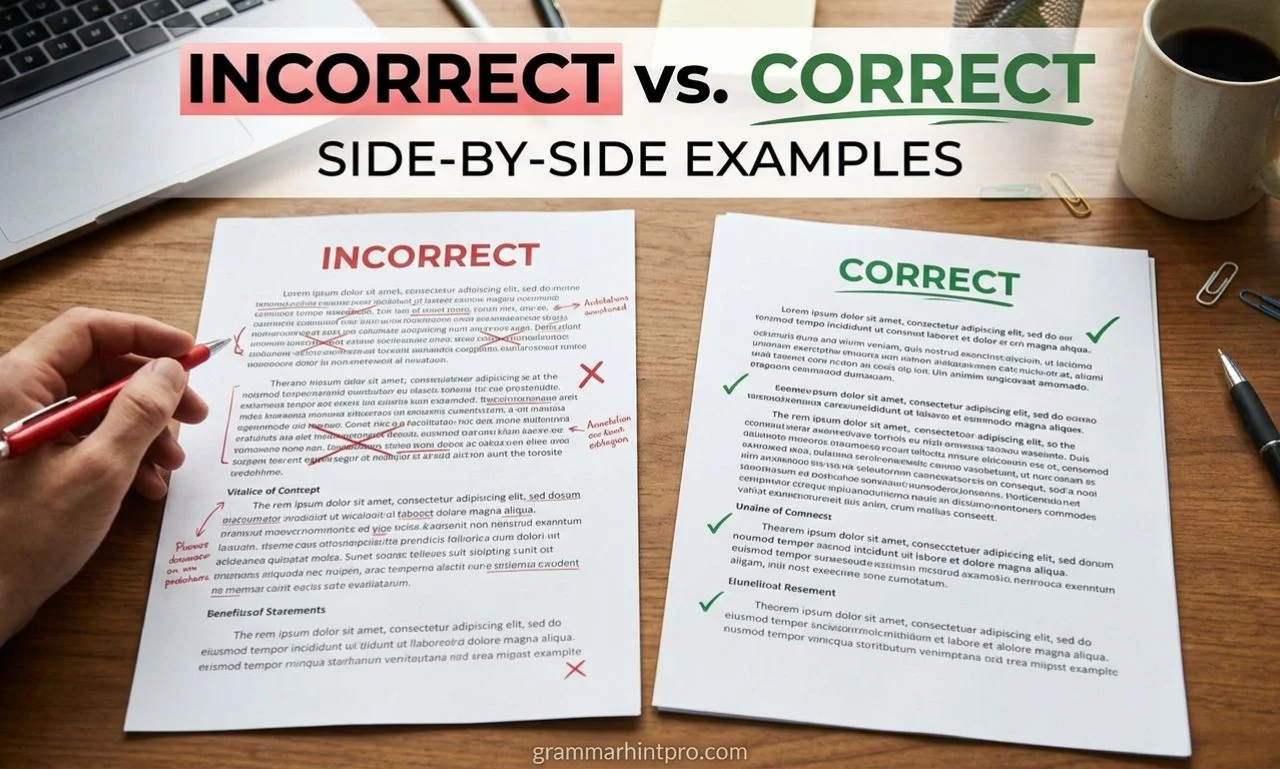
| Incorrect | Correct |
| The books were layed out neatly. | The books were laid out neatly. |
| She layed out the proposal. | She laid out the proposal. |
| We had layed out the materials. | We had laid out the materials. |
| He layed out the costs. | He laid out the costs. |
| The teacher layed out the instructions. | The teacher laid out the instructions. |
| They layed out the furniture. | They laid out the furniture. |
| She has layed out the evidence. | She has laid out the evidence. |
There’s no tense in which standard modern English suddenly requires layed.
Is “Layed” Ever Correct?
This question deserves a more careful answer than a simple “never.”
Layed has appeared historically as a form of lay. Historical English contains spellings and verb forms that don’t match modern standard usage.
That fact doesn’t make layed out an acceptable choice in contemporary edited English.
The practical distinction is important:
Historical existence does not equal modern standard usage.
If you’re writing an essay, article, report, email, application, or other contemporary document, use laid out.
There is no practical reason to choose layed out in ordinary modern US English.
What About Historical Texts?
Older texts can contain forms that modern readers rarely encounter.
English has changed substantially over time. Spelling wasn’t always standardized in the way it is today, and writers sometimes used variant forms.
That means a historical occurrence of layed should be treated as evidence of historical usage rather than as permission to use the form in current writing.
For modern readers, the useful rule remains:
lay → laid → laid
“Laid Out” vs. “Layout”
One additional distinction causes confusion because the words look closely related.
Laid out is a verb phrase.
Layout is usually a noun.
Compare:
The designer laid out the website.
Here, laid out describes an action.
Now compare:
The website has a clean layout.
Here, layout names the arrangement itself.
Dictionary.com defines layout as an arrangement or plan and traces the noun to the verb phrase lay out.
Compare the Forms
| Form | Function | Example |
| lay out | Verb, present | We lay out the materials. |
| laid out | Verb, past/past participle | We laid out the materials. |
| laying out | Verb, progressive | We are laying out the materials. |
| layout | Noun | The layout looks clean. |
This distinction becomes especially useful in writing about design, publishing, websites, architecture, and documents.
Where You’ll See “Laid Out” Most Often
The phrase appears across many kinds of writing because its meanings extend beyond physical arrangement.
Professional Writing
Business writers frequently use laid out when describing plans, responsibilities, strategies, requirements, and proposals.
The agreement laid out the responsibilities of both parties.
This use is precise and natural.
Academic Writing
Academic writers may use the phrase when describing how an argument or study presents information.
The paper laid out the evidence supporting the hypothesis.
However, formal writing often has other options, such as outlined, presented, explained, or described. Choose whichever conveys the exact meaning you want.
Content Marketing and Blogging
Writers commonly use laid out when discussing explanations, guides, strategies, and information architecture.
The guide laid out the steps readers need to follow.
It works especially well when the information appears in a clear sequence.
Everyday Communication
The phrase is equally natural in ordinary conversation:
I laid out your clothes for tomorrow.
She laid out the situation for me.
We laid out everything we needed before leaving.
Its usefulness comes from its flexibility. The same two words can describe physical arrangement or organized information.
A Simple Memory Trick for “Laid Out”
The most reliable memory trick is also the shortest:
Lay → Laid → Laid
Now add out:
Lay out → Laid out → Laid out
That’s it.
Don’t memorize layed as a possible form. Doing so only creates another choice to second-guess later.
Use the Yesterday Test
When you’re unsure, place the action in the past.
Yesterday, she ___ the documents on the desk.
The answer is laid.
So:
Yesterday, she laid out the documents on the desk.
If you’re describing the present:
She lays out the documents every morning.
If you’re describing an action happening right now:
She is laying out the documents.
The pattern becomes:
| Time/Form | Correct Form |
| Present | lay out |
| Third-person present | lays out |
| Present progressive | laying out |
| Past | laid out |
| Past participle | laid out |
Frequently Asked Questions About Laid Out vs. Layed Out
Q1. Is “laid out” correct?
Yes. Laid out is the correct standard form when lay out refers to something that happened in the past or uses the past participle.
Example: The teacher laid out the instructions clearly.
Q2. Is “layed out” correct?
No. Layed out isn’t the standard modern English form of lay out. The correct form is laid out.
Q3. Why is it “laid out” and not “layed out”?
Because lay is an irregular verb. Its forms are:
lay → laid → laid
English doesn’t always form past tense by adding -ed, so layed isn’t the standard past form.
Q4. What is the past tense of “lay”?
The past tense of lay is laid.
- Present: I lay the book on the desk.
- Past: I laid the book on the desk.
Q5. What is the past participle of “lay”?
The past participle is also laid.
For example:
She has laid the papers on the table.
This is why you also write has laid out, had laid out, and have laid out.
Conclusion
When it comes to laid out vs. layed out, the correct form is clear: laid out is the standard spelling in modern English.
The confusion comes from the irregular verb lay. Unlike regular verbs that simply take -ed, lay changes to laid in both the past tense and past participle:
lay → laid → laid
That rule stays the same when lay combines with out. You write lay out in the present and laid out when referring to a completed action.
For example:
- Present: She lays out the documents every morning.
- Past: She laid out the documents yesterday.
- Progressive: She is laying out the documents now.
- Perfect: She has laid out the documents already.
The phrase itself has several meanings. You can lay out physical objects, explain an argument, present a plan, spend money, or use the expression in certain informal contexts. The meaning changes with the sentence, but the spelling of the past form doesn’t.
The biggest trap is confusing lay with lie. Remember that lay generally means to put or place something, while lie means to recline or rest. Once you understand their different verb forms, laid out vs. layed out becomes much easier to handle.
So, when you’re writing an email, article, report, essay, or everyday message, choose laid out.
“Layed out” isn’t the standard modern form.
3 thoughts on “Laid Out vs. Layed Out: 5 Powerful Spelling Rules”