


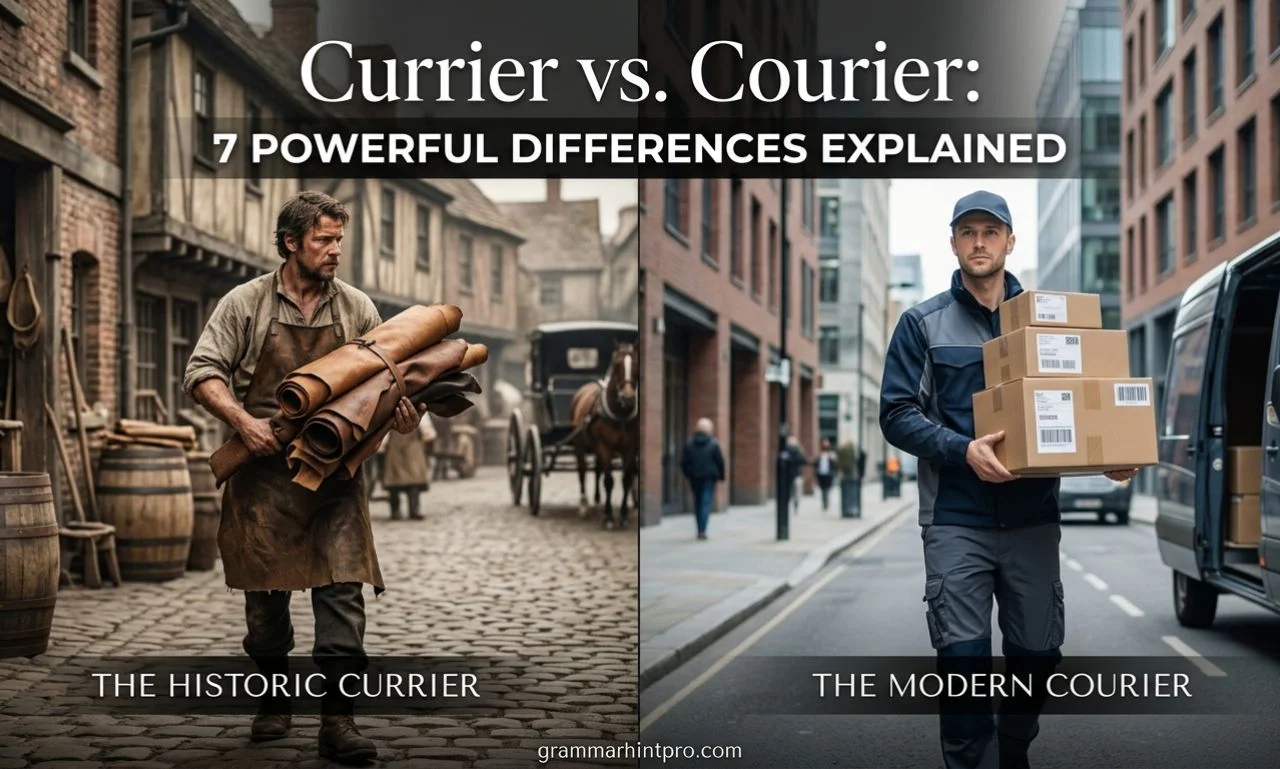
Have you ever wondered whether to write currier or courier? These two words look and sound almost identical, but they have completely different meanings and uses. Understanding the difference between currier vs. courier can help you avoid spelling mistakes and choose the correct word in your writing.
The main difference is simple: a currier is a craftsperson who treats, dyes, and finishes tanned leather to make it suitable for different uses. In contrast, a courier is a person or company responsible for delivering packages, documents, letters, or messages from one place to another. For example, you might encounter a currier in a discussion about traditional leatherworking, while a courier might deliver an important business contract to your office.
Although both words have similar spellings and pronunciation, their meanings, origins, and everyday applications are quite different. Knowing when to use currier and courier is especially important when writing professional emails, articles, business documents, or everyday sentences.
In this guide, we’ll explore currier vs. courier in detail, including their definitions, pronunciation, origins, key differences, and practical sentence examples. You’ll also learn common spelling mistakes and take a quick quiz to test your understanding. By the end, you’ll know exactly which word to use in any context.
What Is the Difference Between Currier and Courier?
The main difference between currier and courier lies in their meanings and the situations in which people use them. Although their spellings are similar, they aren’t interchangeable.
A currier works with leather, while a courier transports items from one place to another. The first word describes a specialized craftsperson. The second usually refers to a delivery person or business, although it can also function as a verb.
| Feature | Currier | Courier |
| Meaning | A person who treats and finishes tanned leather | A person or company that delivers items |
| Main context | Leatherworking and traditional crafts | Shipping, transportation, and business communication |
| Part of speech | Noun | Noun and verb |
| Typical phrase | Leather currier | Courier service |
| Example | The currier finished the leather. | The courier delivered the package. |
| Plural | Curriers | Couriers |
Consider two situations. A leather workshop hires a currier to improve the texture and finish of tanned hides. Meanwhile, a law firm hires a courier to deliver signed documents to a client.
Both words describe legitimate occupations, but their responsibilities have nothing in common.
Quick memory tip: A currier treats leather; a courier carries deliveries. When you’re unsure which word to use, look at the action described in your sentence.
If you often confuse words that sound alike, check out our guide on Unfazed vs. Unphased to learn their meanings, differences, and correct usage with practical examples.
What Does Currier Mean?

The word currier refers primarily to a person who treats, dresses, or finishes leather after tanning. It’s a specialized occupational term rooted in the traditional leatherworking trade.
Although the word appears less often in everyday conversation than courier, it remains a valid English word. You’ll most likely encounter it in historical documents, descriptions of leather production, occupational records, and discussions of traditional craftsmanship.
Currier Definition and Meaning
A currier is a leatherworker who processes tanned hides to improve their usefulness, appearance, texture, or finish. The work traditionally follows the tanning stage, which converts animal hides into leather through a process that makes them more durable and resistant to decay.
Tanning and currying are related but distinct stages of leather production. Tanning stabilizes the hide, while currying involves further treatment that prepares the leather for its intended use.
Depending on the leather and the desired result, finishing work may include operations such as:
- Softening: Making the leather more flexible and suitable for its intended purpose.
- Dressing: Applying treatments or working the surface to achieve particular qualities.
- Coloring: Adding or adjusting color when the production process requires it.
- Finishing: Improving the leather’s appearance, feel, and suitability for a particular product.
The exact tasks vary with the type of leather, production method, and finished product. Not every currier performs every operation listed above.
For example, leather intended for footwear may need different qualities from leather used in upholstery or saddlery. A currier’s work helps prepare the material for its next stage of production.
The distinction matters because a currier doesn’t simply make finished leather goods. A shoemaker, for instance, makes or repairs footwear, while a currier specializes in preparing or finishing leather.
The historical importance of this occupation is easy to understand. Before modern industrial production became widespread, leather supported the manufacture of shoes, belts, saddles, book covers, clothing, and many other everyday items. Skilled curriers helped turn tanned hides into useful materials for these products.
Currier Definition in Real-World Usage
The word currier makes sense when a sentence refers to leather treatment, traditional manufacturing, or the history of skilled trades.
Here are several examples:
- Traditional craftsmanship: The currier softened the leather before the workshop used it to make saddles.
- Historical writing: The town’s records listed a currier among its working tradespeople.
- Leather production: An experienced currier inspected the finished hide for defects.
- Occupational history: The museum displayed tools once used by curriers and other leatherworkers.
Notice the contextual clues in these examples. Words such as hide, leather, saddle, and workshop signal that the sentence concerns leatherworking rather than delivery.
The occupation also appears in historical accounts of urban trade. Leatherworking involved several distinct skills, and different craftspeople could handle different stages of production. In some places, trade rules even separated the work of curriers from that of shoemakers.
For readers researching family history, currier may also appear in an old census, occupational register, newspaper, or birth record. In such cases, it usually identifies a person’s trade rather than a shipping-related job.
Currier Pronunciation
In American English, currier is commonly pronounced approximately KUR-ee-er, with stress on the first syllable. A dictionary-style IPA transcription is /ˈkɝː.i.ɚ/, though phonetic details vary by accent.
The word contains three syllabic parts in many pronunciations, and its final sound can be reduced in ordinary conversation.
To practice saying it:
- Start with the stressed first syllable.
- Move smoothly into the middle vowel sound.
- Finish with the unstressed ending.
The most useful approach is to listen to a dictionary recording and repeat the word in a complete sentence. That helps you hear how its sounds connect during natural speech.
Currier as a Surname and in Currier & Ives
Currier can also appear as a surname. Capitalization matters here because a family name or business name doesn’t necessarily describe someone’s occupation.
One well-known historical example is Currier & Ives, the American printmaking firm associated with Nathaniel Currier and James Merritt Ives. The firm became known for lithographic prints depicting American life, landscapes, events, and popular subjects.
In this name, Currier identifies a person rather than a leatherworking occupation. It also has nothing to do with the delivery-related meaning of courier.
The distinction illustrates an important rule in English: a word can function as an ordinary noun in one context and appear as a proper name in another. Always use the surrounding sentence to determine the intended meaning.
What Does Courier Mean?
A courier is a person or company that transports packages, documents, messages, or other items from one location to another. The word commonly appears in shipping, business communication, legal work, and everyday discussions of delivery services.
Unlike currier, which refers to a specialized leatherworking occupation, courier has several common uses in modern English. It can identify a delivery worker, describe a business that provides transportation services, or serve as a verb meaning to send something through a courier.
Courier Definition and Meaning
The most familiar meaning of courier is a person who delivers something to a recipient. A courier may travel by bicycle, motorcycle, car, van, or another suitable means of transport.
The term also applies to companies that organize and provide delivery services. Depending on the service, a courier may transport documents, parcels, business supplies, medical materials, or other goods.
Common examples include:
- Document delivery: A courier takes a signed contract from one office to another.
- Parcel delivery: A courier transports an online purchase to a customer’s address.
- Business communication: A company uses a courier to move important paperwork between branches.
- Specialized transportation: A courier service handles items that require specific delivery arrangements.
A courier isn’t necessarily an employee of a large delivery company. The word can describe an individual who performs deliveries independently, a worker employed by a service provider, or a business that offers transportation.
The term also appears in tourism, particularly in British English. A courier may be a person who accompanies or assists a group of travelers during a trip. Context determines whether the word refers to a delivery service or a travel-related role.
Courier Pronunciation
In American English, courier is commonly pronounced KUR-ee-er, although some speakers use a vowel closer to the sound in cure. Dictionaries record pronunciation differences across English accents.
One broad American pronunciation is /ˈkʊr.i.ɚ/. Another common form uses /ˈkɝː.i.ɚ/. The precise realization depends on the speaker’s accent and how they pronounce the vowel and the following r.
The word generally carries stress on its first syllable. When speaking naturally, avoid giving every syllable equal emphasis.
A practical way to learn the pronunciation is to compare audio recordings from a reputable dictionary, then practice the word in a sentence:
“The courier delivered the package this morning.”
Listening to full sentences is particularly useful because connected speech can make unstressed vowels sound less distinct..
Can Courier Be Used as a Verb?
Yes. Although courier most commonly appears as a noun, English also uses it as a verb meaning to send or transport something through a courier service.
For example:
- “We will courier the original documents tomorrow.”
- “The company couriered the signed agreement to its regional office.”
- “She is couriering the package to the customer.”
The grammatical forms follow ordinary English patterns:
| Form | Example |
| Base form | courier |
| Third-person singular | couriers |
| Past tense | couriered |
| Present participle | couriering |
The verb is especially useful in professional communication, where it can describe a specific delivery arrangement.
Compare these sentences:
- “We will send the documents tomorrow.”
- “We will courier the documents tomorrow.”
The first sentence is broader. The second specifically suggests that the documents will go through a courier service.
However, courier can sound formal or businesslike in casual conversation. In an everyday message, “I’ll send the package tomorrow” may feel more natural if the delivery method doesn’t matter.
Courier in Everyday and Professional English
The word courier appears in many practical situations because people and organizations regularly move items between locations.
In a business email, you might read:
“Please arrange for a courier to collect the signed contract from reception.”
In a delivery update, a company might write:
“Your parcel has been handed to the courier for delivery.”
In an office conversation, someone might say:
“We need to courier these documents before the deadline.”
Each example uses the word correctly, but the grammatical role changes. In the first two sentences, courier is a noun. In the third, it’s a verb.
This distinction can help you write more precisely. If you’re referring to the person collecting an item, use courier as a noun. If you’re describing the act of sending an item through a courier service, the verb may fit.
Courier, Mail Carrier, and Delivery Service: Are They the Same?
These terms overlap, but they aren’t always interchangeable.
| Term | Typical meaning |
| Courier | A person or service that transports items for delivery |
| Mail carrier | A worker who delivers mail, often as part of a postal system |
| Delivery service | A broad term for a business or operation that transports goods |
| Postal service | An organization or system responsible for collecting and delivering mail |
A courier service may offer direct collection, scheduled delivery, tracking, or specialized transport. However, these features depend on the provider and the service selected. They aren’t guaranteed simply because a business calls itself a courier.
Likewise, a postal service can deliver parcels and documents, but that doesn’t make courier and postal service exact synonyms.
The distinction is useful when choosing terminology for a business document. Use the term that accurately describes the organization or delivery arrangement rather than treating every form of transportation as the same service.
Want to improve your spelling accuracy? Check out our guide on Finaly vs. Finally to learn the correct spelling, meaning, and usage with clear examples.
Currier vs. Courier: Key Differences at a Glance

The clearest way to remember currier vs. courier is to connect each word with its main action. A currier prepares leather. A courier delivers items.
| Comparison point | Currier | Courier |
| Core meaning | Leather-finishing craftsperson | Delivery person or service |
| Main activity | Treating or finishing tanned leather | Transporting items to a destination |
| Typical setting | Leather workshop or historical trade | Office, delivery network, or shipping operation |
| Common related words | Leather, hide, tanning, finishing | Parcel, delivery, documents, tracking |
| Part of speech | Noun | Noun and verb |
| Correct phrase | Skilled currier | Express courier |
| Example | The currier examined the leather. | The courier collected the package. |
The table highlights the most important difference, but context still matters. A sentence containing the surname Currier may refer to a person rather than a craftsperson. Similarly, a sentence using courier as a verb describes an action rather than identifying a delivery worker.
When editing a sentence, identify what the subject does before checking the spelling. That simple step prevents most mistakes involving these words.
Currier or Courier? How to Choose the Correct Word
Choosing between these spellings becomes easier when you look at the meaning of the sentence instead of focusing only on the letters.
Use Currier When Referring to Leatherwork
Choose currier when the sentence describes someone who treats or finishes tanned leather.
For example:
“The currier prepared the leather before the manufacturer began making belts.”
The words leather and prepared establish the context. A delivery worker wouldn’t normally perform this specialized task.
Other useful clues include:
- Tanned hides
- Leather finishing
- Traditional crafts
- Saddlery and leather goods
- Historical occupations
Remember that currier can also appear as a surname. Capitalization and context help distinguish the occupational noun from a person’s name.
Use Courier When Referring to Deliveries
Choose courier when you mean a person or company that transports items. Use it as a verb when describing the act of sending something through a courier service.
Consider these examples:
- “The courier delivered the package to the reception desk.”
- “We hired a courier to transport the documents.”
- “Please courier the signed agreement to our head office.”
The words package, documents, delivered, and transport provide strong contextual clues.
If the sentence concerns shipping, collections, deliveries, or the movement of paperwork, courier is usually the correct choice.
A Simple Trick to Remember the Difference
Use this memory aid:
Currier = leather. Courier = delivery.
The spelling difference may seem small, but the meaning changes completely. Instead of memorizing the words as isolated letter patterns, connect each one with a familiar action.
You can also remember them through short phrases:
- “The currier treats leather.”
- “The courier delivers parcels.”
Repeat the phrases when you practice spelling. Linking a word to its meaning often makes it easier to recall than memorizing its letters alone.
Common Mistakes When Using Currier and Courier

Because the two words look similar, writers may accidentally substitute one for the other. The best correction depends on what the sentence is trying to communicate.
Mistake: Writing “Currier Service” for a Delivery Business
Incorrect: “The company hired a currier service to deliver the package.”
Correct: “The company hired a courier service to deliver the package.”
The corrected sentence refers to a delivery business, so courier is the appropriate word.
Mistake: Using Courier for a Leatherworker
Incorrect: “The courier softened the leather for the saddler.”
Correct: “The currier softened the leather for the saddler.”
In this example, the person treats leather rather than transporting an item. The context calls for currier.
Mistake: Assuming the Words Are Spelling Variants
Some writers assume that currier is simply an alternative spelling of courier. It isn’t. Both are established English words with separate meanings.
Incorrect assumption: “Either spelling works when referring to a package delivery.”
Correct understanding: Use courier for the delivery-related meaning. Reserve currier for its leatherworking meaning or an appropriate proper name.
Mistake: Confusing a Surname With an Ordinary Noun
Incorrect assumption: Every appearance of Currier refers to a leatherworker.
Correct understanding: In a sentence about Currier & Ives, Currier is part of a proper name. The surrounding context identifies the intended reference.
These examples show why proofreading requires more than spell-checking. A spelling checker might recognize both words as valid English, even when you’ve used the wrong one for the intended meaning.
The most reliable correction method is to read the entire sentence and ask: Does this person prepare leather or deliver something?
For more helpful grammar tips, spelling explanations, and easy-to-understand English lessons, visit Grammar Hint Pro and improve your English skills.
Currier vs. Courier Example Sentences
Examples help turn a definition into a practical writing skill. The following sentences demonstrate how each word works in context.
Examples Using Currier
- “The currier finished the hide before it went to the leather-goods workshop.” The word refers to a worker who prepares tanned leather.
- “A skilled currier understood how different treatments affected the leather’s texture.” The sentence highlights the specialized knowledge involved in leather finishing.
- “The historical record identified Thomas as a currier.” Here, the word describes a person’s occupation.
- “The currier inspected the material before the next production stage.” The leatherworking context makes the intended meaning clear.
- “The museum displayed tools associated with the traditional currier’s trade.” The word appears in a historical and occupational context.
In each example, currier connects to leather, a workshop, an occupation, or the history of craftsmanship.
Examples Using Courier
- “The courier delivered the signed contract before the office closed.” The word identifies a delivery worker.
- “We hired a courier to transport the original documents.” Here, it refers to a person or service arranged for a specific task.
- “The courier collected the parcel from the warehouse.” The sentence describes the collection stage of a delivery.
- “Please courier the paperwork to our regional office.” In this example, courier functions as a verb.
- “The business uses a courier service for urgent document deliveries.” The word describes a type of transportation service.
Notice that courier can function as either a noun or a verb. Its role depends on the sentence, but its delivery-related meaning remains consistent.
Frequently Asked Questions
Q1. Is Currier a Real Word?
Yes. Currier is a recognized English noun that refers primarily to someone who treats and finishes tanned leather. It also appears as a surname and in proper names such as Currier & Ives.
Although the occupational meaning is less common in everyday conversation, that doesn’t make the word incorrect or obsolete.
Q2. Is Courier the Correct Spelling for a Delivery Service?
Yes. Courier service is the standard spelling when referring to a business or service that transports packages, documents, and other items.
For example: “The courier service collected the package this afternoon.”
Use currier only when the intended meaning involves leatherworking or a relevant proper name.
Q3. Are Currier and Courier Pronounced the Same Way?
Their pronunciations are similar, and some speakers may pronounce them almost identically. However, vowel sounds can vary by accent, so there isn’t one universal pronunciation pattern shared by every English speaker.
If pronunciation matters for a presentation, lesson, or recording, consult a dictionary that provides audio examples.
Q4. What Is the Plural of Currier and Courier?
The regular plural forms are:
- Currier → curriers
- Courier → couriers
Examples:
“The workshop employed two curriers.”
“The company hired three couriers.”
Both words form their plurals by adding -s.
Q5. Can Courier Be Used as a Verb?
Yes. Courier can mean to send or transport something through a courier service.
For example: “I’ll courier the original agreement tomorrow.”
The past tense is couriered, as in “The office couriered the documents yesterday.”
Conclusion
The difference between currier and courier comes down to meaning and context. A currier treats or finishes tanned leather, while a courier delivers packages, documents, or messages. The words have similar spellings, but they serve different purposes in English.
Use currier when discussing leatherworking, traditional crafts, or the relevant proper name. Choose courier when referring to a delivery worker, a delivery company, or the act of sending something through a courier service.
When you’re unsure, look at the action in your sentence. If the person works with leather, currier is the right choice. If the person transports an item, use courier. That simple distinction will help you spell both words correctly and use them with confidence.
2 thoughts on “Currier vs. Courier: 7 Powerful Differences Explained”