



Flys vs. flies is a common spelling question because English usually forms plurals and third-person singular verbs by adding -s. That pattern makes flys look perfectly reasonable at first glance.
However, standard English uses flies, not flys, for the ordinary plural of fly and for the third-person singular present form of the verb fly. Major dictionaries list flies as the standard form. Oxford, for example, gives the verb forms as I/you/we/they fly but he/she/it flies, while its noun entry gives the plural as flies.
There is one interesting wrinkle: flys has appeared in specialized historical and proper-name contexts. A historical noun fly, referring to a type of carriage, had the plural flys in some older usage. Today, you may also encounter Flys inside brand names or other proper names.
For normal writing, though, the choice is straightforward:
Use “flies,” not “flys.”
Flys vs. Flies: The Quick Answer
If you’re deciding between flys or flies, use flies in standard modern English.
It has two major grammatical uses:
- Plural noun: Several flies landed on the window.
- Third-person singular verb: The bird flies over the lake.
The spelling flys is not the standard form for either use.
| Form | Standard? | Function | Example |
| fly | Yes | Singular noun or base verb | A fly landed here. |
| flies | Yes | Plural noun | Three flies landed here. |
| flies | Yes | Third-person singular verb | The bird flies south. |
| flew | Yes | Past tense | The bird flew away. |
| flown | Yes | Past participle | The bird has flown away. |
| flys | Generally no | Not the standard noun or verb form | The bird flys ❌ |
The important point is that flies isn’t merely a different spelling of flys. It represents a standard grammatical form of fly.
Unsure about the correct spelling of this commonly confused word? Read our guide on Comparable vs. Comprable to understand the correct spelling, meaning, and usage with simple examples.
What Does “Flies” Mean?
The word flies can mean different things depending on its role in a sentence. Most often, it either refers to multiple insects or functions as a verb.
Flies as the Plural of Fly
As a noun, fly can refer to a small flying insect. Its standard plural is flies.
Oxford defines fly as a countable insect and explicitly gives the plural as flies. Cambridge does the same.
For example:
- A fly landed on the table.
- Two flies landed on the table.
- The flies gathered around the fruit.
- Several flies were buzzing near the window.
The change is:
fly → flies
The spelling doesn’t become flys.
The same pattern appears in other words ending in a consonant followed by y:
- baby → babies
- city → cities
- country → countries
- party → parties
- story → stories
English spelling isn’t perfectly predictable, but this pattern is highly useful.
Flies as a Verb
Flies also functions as the third-person singular present form of fly.
Compare these forms:
- I fly.
- You fly.
- We fly.
- They fly.
- He flies.
- She flies.
- It flies.
Oxford’s verb entry specifically lists he/she/it flies as the third-person singular form.
Consider the difference:
Birds fly south in winter.
Here, birds is plural, so the base verb fly follows it.
Now compare:
The bird flies south in winter.
Here, bird is singular. The third-person singular form flies is required.
That’s why this sentence is incorrect:
❌ The bird flys south.
The correct version is:
✅ The bird flies south.
Flies in Figurative Expressions
The verb flies doesn’t always describe physical movement through the air.
For example:
Time flies when you’re having fun.
Here, flies means that time seems to pass quickly. Cambridge specifically includes this meaning among the uses of fly.
You can also say:
- The weekend flies by.
- The summer seems to fly by.
- The years fly by when you’re busy.
So if you’re wondering whether flies always has something to do with insects, the answer is no.
What Does “Flys” Mean?
In ordinary modern English, flys isn’t the standard plural of fly or the standard third-person singular form of the verb fly.
That distinction matters because you’ll sometimes see flys online and assume it must be an alternative spelling.
It isn’t an alternative spelling in ordinary standard usage.
Is “Flys” Ever a Real Word?
There are limited situations in which you may encounter flys.
One historical use involved fly as the name of a type of carriage. Historical sources record flys as its plural. Wiktionary also records this older noun usage and a historical plural connected with the butterfly stroke.
That doesn’t change the modern spelling rule.
There’s another important category: proper names.
For example, the eyewear company Black Flys deliberately uses the spelling Black Flys as its brand name.
A proper name can preserve an unusual spelling because names aren’t required to follow ordinary inflection rules.
So you might legitimately encounter Flys in:
- A company name
- A brand name
- A product name
- A surname
- A title
- A username
- A historical text
- A quotation that preserves original wording
The key distinction is simple: a specialized name doesn’t make “flys” the standard spelling of the ordinary word.
Why Do People Confuse Flys and Flies?
The confusion makes sense because adding -s is one of the most common English patterns.
Consider:
- cat → cats
- book → books
- car → cars
- plane → planes
When people see fly, their first instinct may be to add s:
fly + s = flys
That instinct works for many words. It just doesn’t work here.
The final y creates a different spelling pattern.
There’s another reason the confusion persists: flies sounds the same whether it functions as a noun or a verb.
Compare:
The flies are everywhere.
and:
The bird flies overhead.
The pronunciation doesn’t tell you which grammatical role you’re dealing with. Context does.
The Important Y-to-IES Rule
The spelling of flies becomes much easier once you understand the underlying pattern.
For many English words ending in consonant + y, the final y changes to i before -es is added.
So:
consonant + y → i + es
Oxford’s grammar guidance gives the general noun pattern as party → parties, while the same spelling principle appears in verbs such as try → tries and study → studies.
Rule One: Consonant + Y
When a word ends in a consonant followed by y, the y commonly changes to i before the plural or third-person singular ending.
Examples include:
| Base word | Correct form |
| fly | flies |
| baby | babies |
| city | cities |
| lady | ladies |
| party | parties |
| try | tries |
| carry | carries |
| study | studies |
| worry | worries |
The important detail is the letter immediately before y.
In fly, that letter is l, which is a consonant.
Therefore:
fly → flies
Rule Two: Vowel + Y
Words ending in a vowel + y generally keep the y and simply take -s.
Compare:
| Base word | Correct form |
| boy | boys |
| toy | toys |
| day | days |
| key | keys |
| play | plays |
| enjoy | enjoys |
| stay | stays |
Notice the difference:
- fly → l + y → flies
- boy → o + y → boys
- play → a + y → plays
This distinction explains why flys feels plausible. Words such as boys and toys train us to expect y + s. But fly belongs to the consonant + y group.
If you often confuse words that sound alike, check out our guide on Unfazed vs. Unphased to learn their meanings, differences, and correct usage with practical examples.
Why “Flys” Looks Right but Isn’t
The spelling flys looks natural because it follows a pattern that works for thousands of ordinary English words.
If fly behaved like toy, the result would indeed be flys.
But it doesn’t.
The letter before the final y determines which spelling pattern applies:
Does the word end in Y?
|
v
What comes before the Y?
/ \
Consonant Vowel
| |
v v
Change Y to I Keep Y
+ add ES + add S
| |
v v
fly → flies toy → toys
baby → babies boy → boys
try → tries play → plays
Once you see that contrast, flies stops looking like an arbitrary exception.
Flys vs. Flies: Side-by-Side Comparison
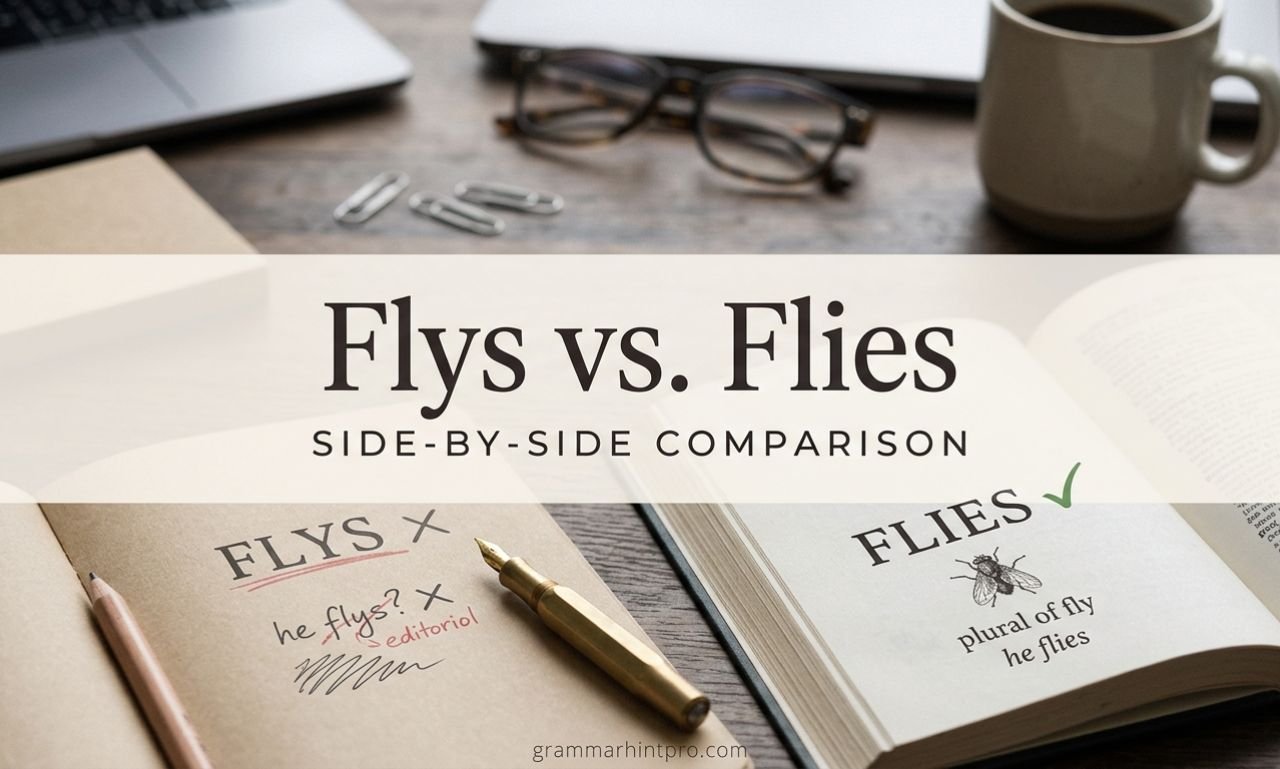
| Feature | Flies | Flys |
| Standard plural of fly | Yes | No |
| Third-person singular of fly | Yes | No |
| Used in time flies | Yes | No |
| Standard spelling in American English | Yes | No |
| Standard spelling in British English | Yes | No |
| Can appear in a brand or proper name | Yes | Yes, if that is the chosen name |
| Historical specialized usage | Yes | Yes, in limited historical contexts |
Cambridge and Oxford both document flies as the standard plural and verb form.
Examples of “Flies” in Everyday Sentences
Seeing the word in different grammatical contexts makes the rule easier to apply.
As a Noun
Here, flies means more than one insect:
- The flies gathered around the trash can.
- Several flies entered through the open window.
- The kitchen had too many flies.
- Birds often eat flies and other insects.
- The farmer noticed flies around the animals.
Oxford notes that many types of fly exist and that some can spread disease.
As a Verb
Here, flies means that a singular subject moves through the air or travels by aircraft:
- The eagle flies above the valley.
- The plane flies from Boston to Chicago.
- She flies to Denver every month.
- The butterfly flies from flower to flower.
- The flag flies above the building.
Cambridge lists several meanings of fly, including moving through the air, traveling by aircraft, and moving quickly.
In Figurative Uses
The word also appears in expressions where the meaning isn’t literal:
- Time flies when you’re having fun.
- The afternoon flies by when you’re busy.
- Rumors fly around the office.
Cambridge records fly for the rapid spread of rumors and for time passing quickly.
Examples of “Flys” in Sentences
For ordinary modern English, flys should be corrected to flies.
| Incorrect | Correct |
| The bird flys south. | The bird flies south. |
| There are three flys outside. | There are three flies outside. |
| She flys to London every month. | She flies to London every month. |
| Time flys so quickly. | Time flies so quickly. |
| The flys are near the food. | The flies are near the food. |
The only time you should preserve Flys in an ordinary sentence is when you’re referring to a specific name or deliberately reproducing historical or quoted wording.
Common Mistakes Writers Make With Flys and Flies
Mistake One: Writing “The Bird Flys South”
The problem is subject-verb agreement combined with spelling.
The subject bird is singular and third person. Therefore, the verb must be flies.
❌ The bird flys south.
✅ The bird flies south.
Mistake Two: Writing “There Are Many Flys”
Here, flies is a plural noun.
❌ There are many flys in the room.
✅ There are many flies in the room.
The noun follows the consonant + y spelling pattern.
Mistake Three: Applying the Wrong Grammar Rule
A common mistake is assuming that every word ending in y simply takes -s.
That doesn’t work.
Compare:
- fly → flies
- try → tries
- carry → carries
- play → plays
- enjoy → enjoys
The letter before the y matters.
Mistake Four: Using “Flies” With a Plural Subject
The opposite error also occurs.
❌ The birds flies south.
✅ The birds fly south.
Why? Birds is plural, so the base verb fly follows it.
This gives you a useful three-way comparison:
| Subject | Correct verb |
| I | fly |
| They | fly |
| The bird | flies |
Why Spell Checkers Flag “Flys”
Most modern spell checkers recognize flies as the standard inflected form of fly.
If you type:
The bird flys over the house.
the software may flag flys because it doesn’t match the expected standard form.
However, spell checkers aren’t infallible. They work from dictionaries, language models, grammatical patterns, and context. A word can be valid in a proper name while still being flagged in an ordinary sentence.
For example, Black Flys is the actual name of an eyewear brand.
So the practical rule is:
Don’t automatically assume a flagged word is meaningless. Check whether it’s a name or specialized term.
Case Study: A Simple Email Mistake
Imagine an employee writes:
Hi James, the bird flys over the warehouse every morning.
The intended meaning is perfectly clear. Yet the spelling still looks unpolished.
The correction is:
Hi James, the bird flies over the warehouse every morning.
Now consider a different sentence:
There are several flys near the loading area.
Again, the intended meaning is obvious. The standard correction is:
There are several flies near the loading area.
This small error illustrates an important writing principle: clarity and correctness aren’t always the same thing. Readers may understand a misspelling instantly, but repeated errors can make professional writing look careless.
Confused about the correct spelling of similar English words? Read our guide on Triple vs. Tripple to understand the spelling difference, meaning, and correct usage with examples.
How Dictionaries Define “Flies”
Authoritative dictionaries give strong evidence about standard usage.
Cambridge defines flies as the plural of fly when referring to insects. It also lists another noun sense involving the opening at the front of trousers.
Oxford’s American English entry likewise defines flies as the plural of fly.
For the verb, Oxford gives:
- I/you/we/they fly
- he/she/it flies
- past: flew
- past participle: flown
That makes the standard pattern unambiguous.
How Dictionaries Define “Flys”
The situation with flys is more complicated than simply saying the sequence of letters can never appear in English.
Historical dictionaries and word references record specialized uses. Wiktionary, for example, records flys as an older plural for a type of carriage and also gives a historical use connected with the butterfly stroke.
That evidence matters because English has changed over time.
Still, those historical uses don’t make flys an acceptable replacement for flies in an ordinary sentence such as:
The flies are buzzing.
For contemporary standard writing, flies is the form to use.
The History Behind the Word “Flies”
The modern spelling makes more sense when you remember that English spelling rules developed over centuries rather than being designed as one neat system.
The spelling pattern involving final y reflects broader changes in English inflection and orthography. Modern grammar references still teach the practical result: words such as party become parties, while words ending in vowel + y generally keep the y.
Interestingly, historical English did contain flys in specialized contexts. A historical discussion of the word fly as a carriage records flys as its plural.
So flys isn’t simply a random sequence someone invented online. It has existed in historical usage. It just isn’t the standard modern plural or verb form you’re looking for today.
Flys vs. Flies in American and British English

American and British English both use flies for the ordinary plural of the insect fly and for the third-person singular present form of the verb.
Cambridge gives the same /flaɪz/ pronunciation for its British and American entries for flies.
There are some differences in other meanings of fly.
For example, Cambridge notes that fly can refer to the front opening of trousers, with flies appearing in British usage in that context.
Those vocabulary differences don’t change the central spelling rule:
fly → flies
in both major varieties of English.
When Should You Use “Flies”?
Use flies when you mean either of these things:
- More than one fly.
- The third-person singular present form of fly.
A quick test can help.
If It’s a Noun
Ask:
Am I talking about more than one fly?
If yes:
flies
Example:
Five flies landed on the table.
If It’s a Verb
Ask:
Is the subject singular and third person?
If yes:
flies
Example:
The plane flies every morning.
If the subject is I, you, we, or they, use fly instead.
The Grammar Rule You Should Memorize
If you remember only one rule, make it this:
When a word ends in a consonant + y, the y commonly changes to i before -es.
For fly:
fly → flies
The same pattern appears in:
- try → tries
- cry → cries
- carry → carries
- study → studies
- worry → worries
But don’t apply the rule blindly.
A vowel before the final y produces a different pattern:
- play → plays
- stay → stays
- enjoy → enjoys
- boy → boys
- toy → toys
The contrast between fly → flies and toy → toys is the key to remembering the rule.
Memory Trick: “Fly Has Its Wings”
Here’s a simple memory aid:
When “fly” changes form, let the Y “fly away” and bring in IES.
So:
fly → flies
You can also remember the short sequence:
One fly. Two flies. He flies.
That single sentence captures both major uses.
It also gives you a useful contrast:
I fly. He flies.
The base verb remains fly with I, while the third-person singular form becomes flies.
Words That Follow the Same Pattern
Once you understand fly → flies, you’ll recognize the same pattern elsewhere.
Nouns
- baby → babies
- city → cities
- country → countries
- family → families
- story → stories
- lady → ladies
- party → parties
Verbs
- try → tries
- carry → carries
- study → studies
- worry → worries
- hurry → hurries
- reply → replies
The spelling principle is consistent across these examples: a final consonant + y changes to -ies.
Words That Follow a Different Pattern
The fastest way to understand the rule is to compare it with words that don’t use it.
| Word | Correct form | Pattern |
| fly | flies | consonant + y |
| baby | babies | consonant + y |
| city | cities | consonant + y |
| try | tries | consonant + y |
| boy | boys | vowel + y |
| toy | toys | vowel + y |
| day | days | vowel + y |
| key | keys | vowel + y |
| play | plays | vowel + y |
| enjoy | enjoys | vowel + y |
This comparison explains why flys looks plausible but fails the standard spelling rule.
Common Phrases That Use “Flies”
“Time Flies”
Time flies means that time seems to pass quickly.
Time flies when you’re having fun.
Here, flies is a verb. The subject time is singular and third person.
“Flies on the Wall”
A fly on the wall is someone who observes a situation without participating in it.
The plural can be flies on the wall when referring to more than one literal insect or figuratively to multiple observers.
Cambridge also lists fly-on-the-wall as a term for a style of documentary or film that observes events without obvious interference.
“Like Flies”
The word flies appears in several comparisons:
People gathered like flies around the food.
It can also appear in idioms such as drop like flies, which Cambridge lists among its idiomatic expressions.
“As the Crow Flies”
As the crow flies means measuring a direct distance rather than following roads or other routes.
Here, flies is again the third-person singular verb.
Flys vs. Flies: A Simple Decision Guide
When you’re unsure, run through these questions:
Do you mean “fly”?
|
v
Is it more than one insect?
/ \
Yes No
| |
v v
FLIES Is “fly” a verb?
|
v
Is the subject singular
and third person?
/ \
Yes No
| |
v v
FLIES FLY
This handles most everyday cases.
For example:
- One fly → fly
- Two flies → flies
- I fly → fly
- They fly → fly
- She flies → flies
- The plane flies → flies
Frequently Asked Questions
Q1. Is “flys” the correct spelling?
No, not in standard modern English when you’re forming the plural of fly or the third-person singular form of the verb fly. The correct form is flies.
Q2. Is “flies” the plural of “fly”?
Yes. Flies is the standard plural of the noun fly.
- One fly
- Two flies
- Several flies
For example: The flies gathered around the fruit.
Q3. Is “flies” a verb?
Yes. Flies is the third-person singular present-tense form of the verb fly.
For example:
The eagle flies over the mountains.
Compare that with:
Eagles fly over the mountains.
Q4. Why does “fly” become “flies”?
Because fly ends in a consonant + y. In this spelling pattern, the y changes to i and -es is added.
fly → flies
The same pattern appears in words such as:
- try → tries
- cry → cries
- carry → carries
- study → studies
Q5. Is “flys” ever a real word?
It can appear in historical, specialized, or proper-name contexts, but it isn’t the standard form for everyday English. A brand or company may deliberately use Flys as part of its name.
Therefore, don’t use flys as an ordinary substitute for flies.
Conclusion
When choosing between flys and flies, the correct spelling in standard modern English is almost always flies. Use flies when you mean more than one insect, as in There are several flies in the kitchen. Use it as a verb when a singular third-person subject performs the action, as in The bird flies across the sky.
The spelling follows a useful English rule. When a word ends in a consonant + y, the y usually changes to i before -es is added. That’s why fly becomes flies, just as try becomes tries and baby becomes babies.
By contrast, flys isn’t the standard plural or verb form in everyday English. You may still encounter Flys in a brand name, proper name, historical text, or specialized context. Those uses don’t change the normal spelling rule.
If you’re ever unsure, remember this simple pattern:
One fly → two flies → he flies.
Once you recognize the consonant + y pattern, the difference between flys vs. flies becomes much easier to remember.
3 thoughts on “Flys vs. Flies: 7 Essential Rules for Correct Spelling”